Thor Jensen on Right-Hand Control, Django Reinhardt, and Navigating Changes with Simplicity
From sunrise practice sessions and Segovia scales to Django-inspired technique and solo guitar exploration, Thor Jensen breaks down the ideas shaping his playing today. He also explains how blues, triads, and voice leading guide his improvisation across jazz, country, and beyond.
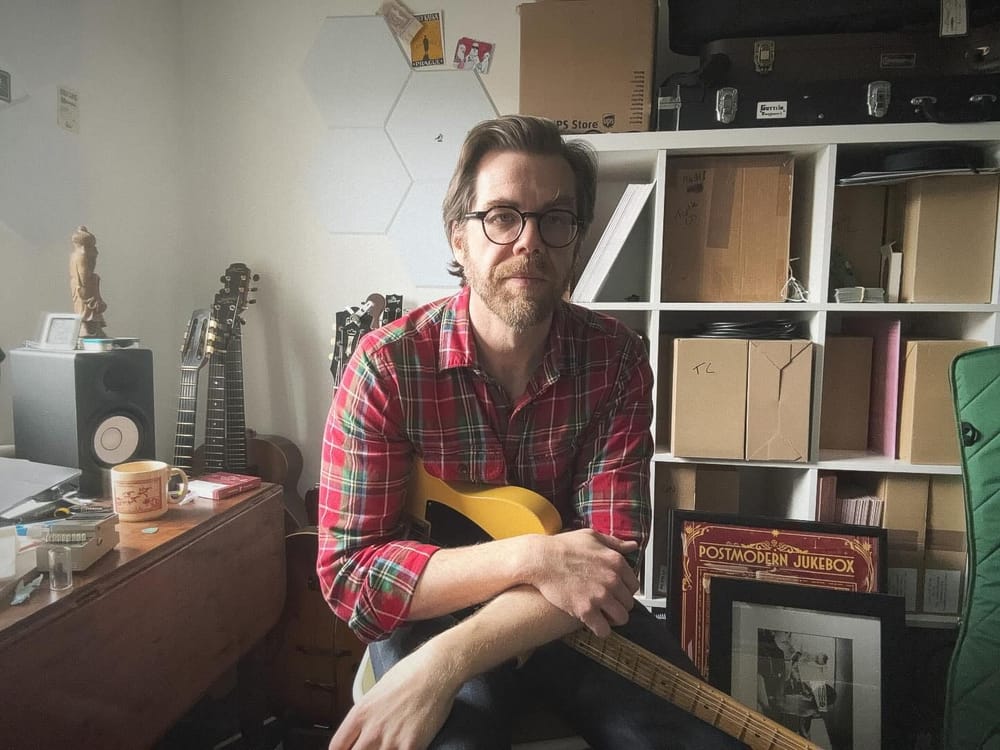
Thor Jensen is a versatile guitarist, songwriter, and bandleader known for blending jazz, blues, country, and Americana influences into a distinctive musical voice. Raised in the Northeast U.S., and now based in London, Jensen has built a career as a touring and session guitarist, performing with artists and projects across a wide range of styles. His playing often combines melodic single-note lines with chord fragments, creating a rich and expressive sound that works equally well in solo settings and ensemble performances.
Jensen has toured internationally with the retro-inspired collective Postmodern Jukebox and spent several years performing with gypsy-jazz guitarist Stéphane Wrembel. Along the way, he has collaborated with a wide range of artists and projects, including Ashley Campbell, while also performing with groups like Hazmat Modine and the rock band Quiet Life. These experiences helped him develop a broad musical vocabulary that draws from early jazz, roots music, rock, and improvisation.
In addition to touring and recording, Jensen regularly shares insights from his playing and practice on his YouTube channel, where he posts lessons, demonstrations, and musical ideas for guitarists. His videos often focus on practical topics like tone, phrasing, improvisation, and hybrid picking, offering useful perspectives drawn from years of performing and studying the instrument.
Jensen also teaches private guitar lessons, working with students both online and in person. Whether performing on stage, recording in the studio, or teaching, he focuses on helping musicians develop their own voice while building a strong foundation in rhythm, tone, and musical listening.
➡️ We caught up with Thor, and he shared how early-morning practice, Segovia scales, and a deep dive into Django Reinhardt’s language shaped his playing. He also discusses hybrid picking, voice leading through chord changes, and why the right hand is where phrasing, grammar, and tone truly live.
🎸 Q & A
What does your typical guitar practice routine look like?
It usually starts with free playing, as close to sunrise as possible. I’m an early riser and I like to start my day with coffee and guitar.
I do my best to go with the flow and let that first play of the day dictate what I’d like to work on. If my hands can’t really land on anything very musical then I’ll go to my old standby the Segovia Scales. I started playing those about 10 years ago and I’m still a bit addicted. I find them to be a great and meditative start to a practice routine: they allow me to concentrate on how I’m playing without worrying about what I’m playing. The way I’m feeling time, the quality of my sound and especially my right hand technique.
If I were to choose one thing I spend the most time thinking about it’s my right hand. I’ve been thinking a lot more about how I want to say things these last few years, and the right hand is all about grammar and punctuation to me.
I’ve been delving into solo playing a lot lately too, so I try to play changes every day. Country songs, jazz tunes, anything really. Sometimes it’s just fleeting improvisation but it can lead to some really cool harmonic navigation or even to writing a tune.
And of course if I have music to learn for a gig that takes up a fair amount of my routine.
What is one practice habit or approach that most accelerated your progress—and why did it work?
When I started getting into Django Reinhardt and trying to learn and understand that language. Learning the vocabulary is hard enough, but the techniques that go with it are essential to the music and I was determined to learn how to do it.
The first 10 years of it was like finding a light switch in an unfamiliar room, but when I joined Stephane Wrembel’s band I really had to bust my ass to keep up. I had major imposter syndrome when I joined them and I really had to treat practice like a job to keep my head above water and I absolutely loved it.
It was hard as hell but it gave me a whole new perspective and appreciation of playing and practicing music. Long story short, learning a specific technique- which is something I’d never really done before - really pushed me and gave me life.
What musical concept or idea has influenced your playing the most?
That’s a bit of a toss up, but probably a pretty even tie between blues and the major scale. The more time I spend with the major scale the deeper the valley gets, and the more time I spend playing blues the more I see it where I’d least expect.
There’s a fantastic video of someone asking George Benson how he plays over a rhythm changes, and he just said he plays blues. That kind of blew my mind and showed me a glimpse of what’s possible with blues.
What’s your current go‑to gear or setup when recording or performing live?
I have a few instruments I love, but I can’t seem to stay away from my tele. It’s bit of a mutt I got a few years ago and it’s been my standby since. Fender Road Worn body, a Fender custom shop neck with big frets, and I put some Lollar pickups in it. I’ve been yearning for a new neck pickup sound so that’s on the agenda.
Pedalboard is getting smaller by the year, but always a light to medium drive (currently JSA Effects Hot Toddy), a Strymon El Capistan, and a reverb. Lately the verb has been a EQD Dispatch Master.
I’ve been on a Jerry Reed kick so I recently got a MXR Phase 95.
My favorite amp is a brown Deluxe -ish combo made by TJ Heimel at Love of Fuzz in Troy, NY. It’s absolutely incredible, but I don’t have a case for it and there’s only one of them so it usually stays home.
I’ve been pretty hooked on my Milkman The Amp 100 for everything these days. It’s on my pedalboard and I run a long speaker cable to a 1x12 for gigs and use the DI out for recording at home. It’s got a nice reverb, a killer boost and is delightfully simple.
What guitarists or musicians have influenced your sound the most?
That’s really hard to narrow down, and I feel like I’m always chasing something. I can tell you this though…..I greatly admire Jim Campilongo’s sonic control, the quality of Gonzalo Bergara’s notes, Charlie Hunter’s richness, and Jerry Reed’s ease. I think I’m a far cry from all of the above, but they all have particular thing I’m always running after.
Your playing often blends single-note lines with chord fragments, frequently using hybrid picking (using both a pick and fingers). How did you develop this approach, and what exercises or tips would you recommend to guitarists wanting to achieve a similar style?
That comes from a variety of places. People like Antoine Boyer, Yamandu Costa and Julian Lage do it so effortlessly and I’ve always admired that, and I definitely have more than a touch of piano envy.
It developed more when I got into the idea of finding some kind of voice as a solo instrument. It’s forever a work in progress. The hybrid element came from stubbornness, if I’m being honest. I always liked the sound of grabbing a chord, but I didn’t want to commit to only using my fingers to pick the strings and I feel more in control with a plectrum.
As far as tips for developing it, I practice it with tunes and voice leading mostly. Find the chord voicing around a melody and try to work my way into the next chord. And like with everything, be patient.
How do you think about playing over chord changes—scales, arpeggios, voice leading, or something else? What exercises help you internalize those changes?
It’s a bit of all of the above. I mostly navigate the changes with arpeggios/triads, and voice leading is kind of always on my mind.
And I keep it basic: major, minor and dominant.
It allows me to keep the changes simple to navigate and wide open to add color onto. Scales are there to see what’s possible around the chord tones, but I never really think with them.
And as far as exercises go, practicing tunes unaccompanied has been the most helpful. Playing a chorus of the changes, then blowing over a chorus and doing my best to sound like the changes are still happening underneath me. It gets easier but never gets easy.
You’ve collaborated with a diverse range of artists (Postmodern Jukebox, Ashley Campbell, Stephane Wrembel, etc.)—how do you adapt your playing to fit such different musical worlds?
My approach to playing with anyone is always basically the same, which is to follow my ears, and try to be as sensitive to my band mates and the music as possible.
Be in tune, be in time and everything should fall into place and allow me to be myself to interpret and respond.
⚡ Lightning Round
One album every guitarist should hear?
Django Reinhardt - Souvenirs
Desert island guitar and amp?
My Tele and my brown Deluxe
What guitarist should everyone know about?
Josh Dunn, amazing player in New York
Key Gear:
- Fender Telecaster (Fender Road Worn body with a Fender Custom Shop neck, & Lollar pickups)
- Brown Deluxe-style amp
- Milkman The Amp 100 amp in a pedal.
- JSA Effects Hot Toddy
- Strymon El Capistan
- Dunlop Gator Grip 1.5mm pick