Original vs. Reissue: How to Spot a Real Vintage Guitar (and Why It's Worth the Hunt)
The newsletter for guitar players.
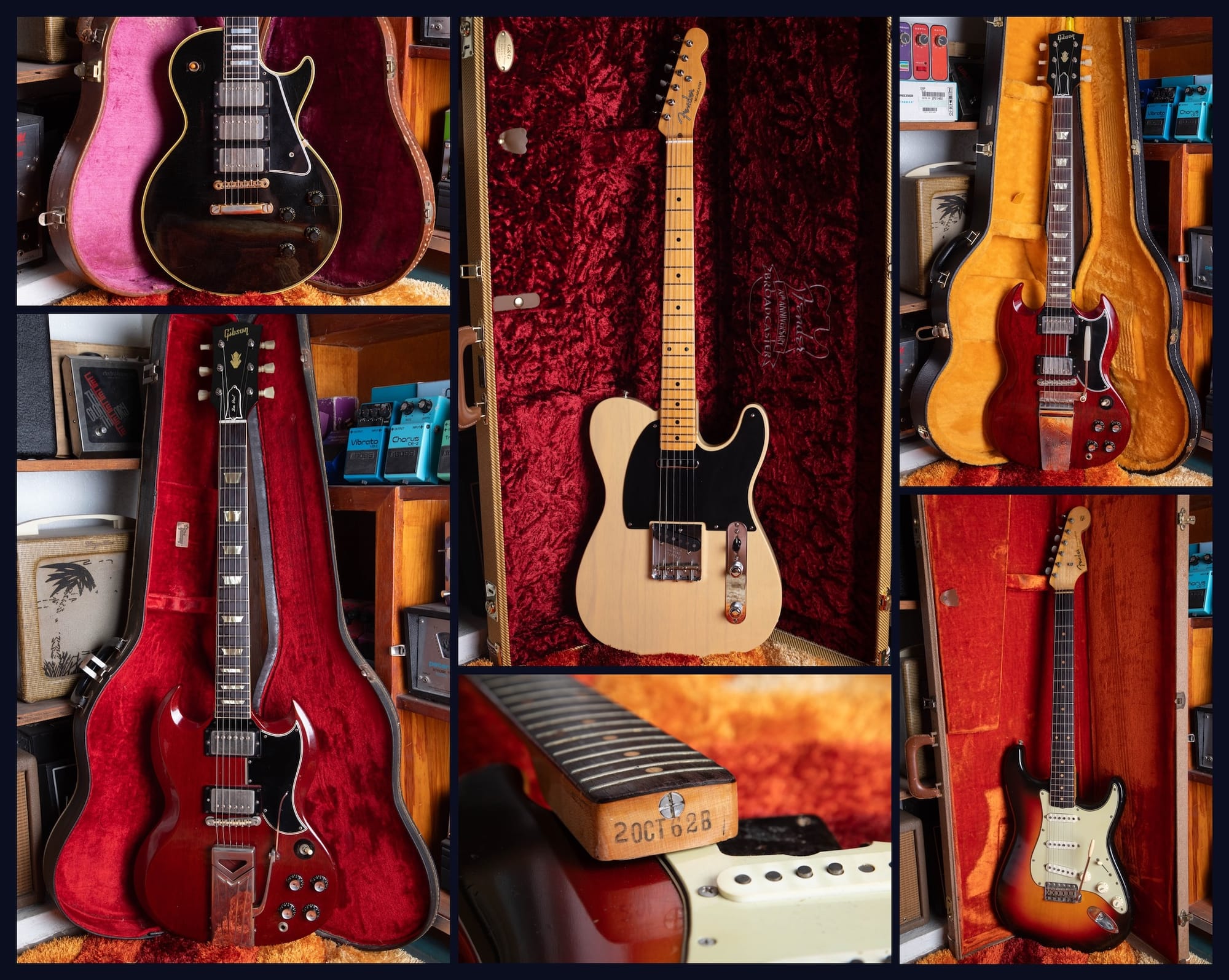

This week, we have a guest post from Joe Dampt from Joe's Vintage Guitars, discussing original vs reissue guitars.
Vintage guitars are more than just old instruments—they’re pieces of history, and knowing how to tell the real thing from a convincing reissue can save you from an expensive mistake. In this field guide, Joe of Joe’s Vintage Guitars breaks down the clues that matter, from serial numbers and pot codes to solder joints, finish checking, hardware, and honest wear. Whether you’re hunting for a pre-CBS Fender or a legendary Gibson Burst, here’s how to separate a true vintage original from a modern copy.
Original vs. Reissue: How to Spot a Real Vintage Guitar (and Why It's Worth the Hunt)
A guest field guide from Joe of Joe's Vintage Guitars
I look at a lot of guitars. Some weeks it's a real 1959 Stratocaster that's been under a bed since the Eisenhower years. Other weeks it's a Custom Shop reissue that the seller swears is "basically the same guitar." Sometimes they believe it. Sometimes they're hoping I won't notice.
A good reissue is a fine instrument, and I'll stick up for them later on. But it isn't the same guitar, and the gap between the two is bigger than most people think. It shows up in the price, in the way the thing feels in your hands, and in what you actually walk away owning. A real 1959 Les Paul Standard can cost as much as a house. The reissue costs about what a used car does, and like a used car it starts losing money the day you buy it.
So knowing how to tell them apart matters. Get it wrong and you're out five figures. Get it right and you might land the guitar of your life. Here's how I go about it.
First, get your head right
A reissue is a copy built to look old. The best ones come out of Fender's Custom Shop and Gibson's Murphy Lab, and they are very convincing. The finish gets checked, the plating gets dulled, the edges get worn, the plastic gets yellowed, all of it on purpose. Aging a guitar is its own craft now, and a well-relic'd reissue will fool you in a phone photo every single time.
That's why you can never hang your hat on one detail. Somebody can fake finish checking. They can age a pickguard. What's hard to fake is all of it lining up at once. So I don't go looking for one smoking gun. I look at the whole guitar and check whether every part of it agrees on the same decade: the serial, the solder, the wood, the wear. When one of those pieces disagrees with the rest, that's when I slow down and start asking questions.
Here's what I actually look at.
The tells that work on almost anything
Serial numbers and date stamps. Good place to start, but don't stop there. Every big brand stamps a date somewhere, and here's the funny part: the reissues basically tell on themselves. Gibson's Historic reissues have an ink-stamped serial on the back of the headstock that starts with the year they're copying. An "R9" is a 1959 reissue. Put that next to a "CS" (Custom Shop) stamp and you know for a fact you've got a modern guitar and not a real Burst. (If you ever want to check a Gibson serial, I keep a free decoder on my site.) And a genuine vintage serial has to line up with everything else on the guitar, so the neck date, the pots, and the hardware all need to agree. One number by itself doesn't tell you much.
Component date codes. This one's my favorite, because it's the toughest thing for a faker to get right. The potentiometers, the parts behind your volume and tone knobs, carry a source-date code. On a CTS pot you'll find a number that starts with 137, which is CTS's manufacturer code, followed by the year and the week. So 1376542 reads as CTS, 1965, week 42. A real 1960 guitar is going to have pots from late 1959 or 1960. It is not going to have pots from 1972. When those dates land years after the guitar was supposedly built, either somebody has been in there swapping parts, or the guitar isn't what the seller says it is.
The logo and decal. On a Fender, the headstock logo by itself will get you close on the year. The thin "spaghetti" logo ran from 1954 to around mid-1964. The bolder gold "transition" logo showed up in 1965. The black CBS logo came in around 1967 or 1968. So if somebody's selling you a "1962" Strat and it's wearing a black logo on a big headstock, you already know something is off. (Fender made the Strat headstock bigger in late 1965, so a small headstock is one of the signs you're looking at a pre-CBS guitar.)
Solder joints and wiring. Take the control cover off and look at the solder. Factory joints from the '50s and '60s are dull, a little lumpy, and untouched, with cloth-covered wire running between them. If you find bright, shiny solder that's been melted and redone, and modern plastic-coated wire, then somebody has been in there. That's not always a problem. But if the seller is telling you the guitar is all original and left the factory this way, it's a question that needs an answer.
Finish and lacquer checking. As old nitrocellulose lacquer ages it shrinks and cracks into fine "checking," a spiderweb of little lines you can feel with a fingernail. The real thing is random, follows the grain and the stress points, and goes down through the color coats. Here's the catch, though. Plenty of good reissues use nitro too, and the checking Gibson's Murphy Lab does is very convincing. So checking on its own doesn't prove a guitar is old. The opposite tells you more. If a guitar is supposed to be sixty years old and the finish is dead clean, that should bother you a lot more than any amount of checking reassures you.
Wear that makes sense. Honest wear follows the way people actually play. Your hand wears the back of the neck where your thumb rides, not in a neat even stripe. Your forearm wears the top. A belt buckle chews up the back. On a guitar that's really been played for decades, the wear all connects, so the frets are worn where the fingerboard is worn, where the neck finish is worn, all in the same spots. Fake relic'ing gives itself away by putting wear where nobody's hand ever goes, or by beating up the finish while the frets, plastic, and hardware still look too fresh. If the wear doesn't match the age, trust your gut.
Hardware, screws, and plastic. The small stuff gives a lot away. Old Fenders used slotted screws, so a Phillips head where a slotted screw belongs means something's been replaced. Old plastic parts, the pickguard, the knobs, the pickup covers, all yellow and shrink over the years. Real celluloid even smells a little like vinegar or camphor as it ages and off-gasses. Reproduction plastic can look right, but it rarely shrinks the way the old stuff does, and it never quite gets the smell.
Now, model by model
Fender Stratocaster: pre-CBS vs. reissue
The pre-CBS Strat (roughly 1954 to 1965) is the one everybody wants, which makes it the one people fake. On top of the spaghetti logo and small headstock, here's what I check:
- Clay dots. Rosewood-board Strats from before about mid-1964 have grayish "clay" position dots. After that Fender switched to white pearloid plastic dots. Reissues use aged repro dots that get close, but they usually look a little too even and perfect.
- Green and mint pickguards. The early single-ply guards, and the later three-ply "mint green" ones, get their color from nitrate plastic slowly aging under light. It's a particular yellow-green that repro guards try to copy but rarely nail.
- Two date stamps. There's a penciled or stamped date on the neck heel, and another date in the neck pocket on the body. Those two should sit within a few months of each other, and within a few months of the pots.
- Custom colors are a world of their own. Under the clear coat, a real early-'60s custom color has period-correct DuPont lacquer, a Fullerplast sealer beneath it, and decades of yellowing in the clear. This is the most faked corner of the whole Fender world. If you're paying the custom-color premium, get a specialist to look at it before you send a dime.
Fender Telecaster: same rules, older bones
Everything above works on the Tele too, so that's the logo era, the pot codes, the slotted screws, and the neck and body dates. A few extras I look at. The bridge should be the right three-saddle type for the year. The "ashtray" bridge cover is usually long gone, and that's fine, since most players pulled them off anyway. And the early blackguard Teles from 1950 to 1954 have their own quirks that are worth running past a specialist. Like always, you want the serial, the pots, the wood, and the wear all telling the same story.
Gibson Les Paul: Burst vs. R9
Nothing in the guitar world has a bigger gap between the original and the reissue than the 1958 to 1960 "Burst." Here's where I look first:
- The headstock stamp. Like I said above, an ink-stamped "R9" or "CS" serial means you've got a reissue. A real Burst has an ink-stamped serial with no "R" in front of it, and a silkscreened "Les Paul Model" on the headstock.
- PAF pickups. The original Patent Applied For humbuckers have a small decal on the underside of the baseplate. One thing worth knowing: a little sanding around that sticker is normal factory work, done so the decal would stick, and you'll see it on real ones. What you're watching for isn't old sanding, it's fresh scraping that cuts through patina that's otherwise even all over. Reading PAFs is real expert territory, so don't go taking anything apart, and don't buy a guitar on the strength of a sticker alone.
- The neck joint and the wood. Bursts have a long neck tenon under the neck pickup, a Brazilian rosewood fingerboard, and a holly veneer on the headstock. Most of them weigh somewhere in the high 8 to mid 9 pound range.
- The plastics and hardware. You want single-line "Kluson Deluxe" tuners, an ABR-1 bridge, and cream-colored plastics that have yellowed toward amber unevenly. On a real one, all the plastic has aged at the same rate.
So why chase the original at all?
If the reissues are this good, why do people (me included) go to all the trouble and expense of buying the real thing? A few honest reasons.
What you hear and feel. I'm not going to pretend tone is something you can put a number on. But old guitars are made of old stuff: lighter, denser wood that grew slowly, thin nitro that finished curing decades ago and has basically stopped moving, hide glue, and hand-work that came out a little different on every guitar. Part of that is romance, sure. But part of it is real, and you feel it the second you play an unplugged '59 Les Paul and it buzzes against your chest. The reissues chase that feeling hard, and the best ones get close. Close is about as far as they get, though.
What you own. This is the cold-eyed part. A reissue is a product. It's well made, it comes with a warranty, and it loses value like any other new gear. An original is a fixed thing. They quit making 1959 Stratocasters back in 1959, and the number left in the world only goes down as guitars get broken, burned, or locked away in collections. Over the last fifty years or so, the good vintage pieces have held their value and then some. Plenty of them have beaten investments that people take a lot more seriously. Buy the right original in good shape and you've got something that can climb in value while you play it. Buy a reissue and you've got a great guitar that's worth less next year than it is today.
What it carries. A real vintage guitar has been somewhere. The wear on it is a record of somebody's band, somebody's bar gigs, somebody's fifty years of playing. A relic'd reissue is dressed up to look like it lived a life it never actually lived. For a lot of us, that history is the whole point of buying vintage in the first place.
In defense of the reissue (yes, really)
I sell vintage for a living and I still tell people to buy reissues all the time. If you gig a lot, travel, sweat all over your guitar, or just can't relax with a five-figure instrument in the house, a Custom Shop reissue or a Murphy Lab Les Paul is the smart move. You get most of the look and feel, you get a warranty, you get modern consistency, and you get to actually play the thing without a heart attack every time it picks up a ding. There's nothing wrong with owning a great copy. The only real mistake is paying original prices for one.
That's the whole reason I put this together. Reissues are great, so buy one if it suits you. Just make sure you know which one is in the case before you hand over the money.
How to buy one without getting burned
- Buy the seller as much as the guitar. A good vintage dealer puts their name on every instrument they sell, and takes it back if it turns out to be wrong. That reputation is the cheapest insurance you'll ever get.
- Get it in writing. A real vintage guitar should come with honest, detailed paperwork covering any repairs, refinishes, or replaced parts. And if a seller gets vague when you ask what's original, that tells you something too.
- Bring a blacklight. Under UV light, touch-ups and any finish that isn't original tend to glow differently than the lacquer around them. It's not foolproof, but it's cheap and it shows you a lot.
- When the money gets serious, pay an expert. On a five-figure custom color or a Burst, having a specialist inspect it costs almost nothing next to the price of the guitar, and it can save you from a very expensive mistake.
Sorting out a vintage guitar really is just detective work. You gather up the clues, and you trust the guitar whose story holds together from the headstock to the control cavity. Learn to do that and you'll stay clear of the fakes. You'll also start to see exactly why the real ones are worth going after in the first place.
Joe runs Joe's Vintage Guitars, where he buys, sells, and appraises pre-CBS Fenders, vintage Gibsons, and other collectible instruments. He does free, no-obligation appraisals and keeps a set of free serial-number and dating guides on the site for anyone trying to figure out what they've got.
Website | Reverb Store | Instagram | Facebook | YouTube
Enjoy this newsletter? Please forward to a friend or hit reply to share your thoughts.🤘