Miles Okazaki on Random Practice, Monk's Hidden Lessons, and Building a Personal Musical Language
Jazz guitarist and composer Miles Okazaki shares the practice concepts that shaped his playing, why he wishes he'd started using a mirror sooner, what guitarists often miss in Thelonious Monk's music, and how creative constraints fuel his compositions.
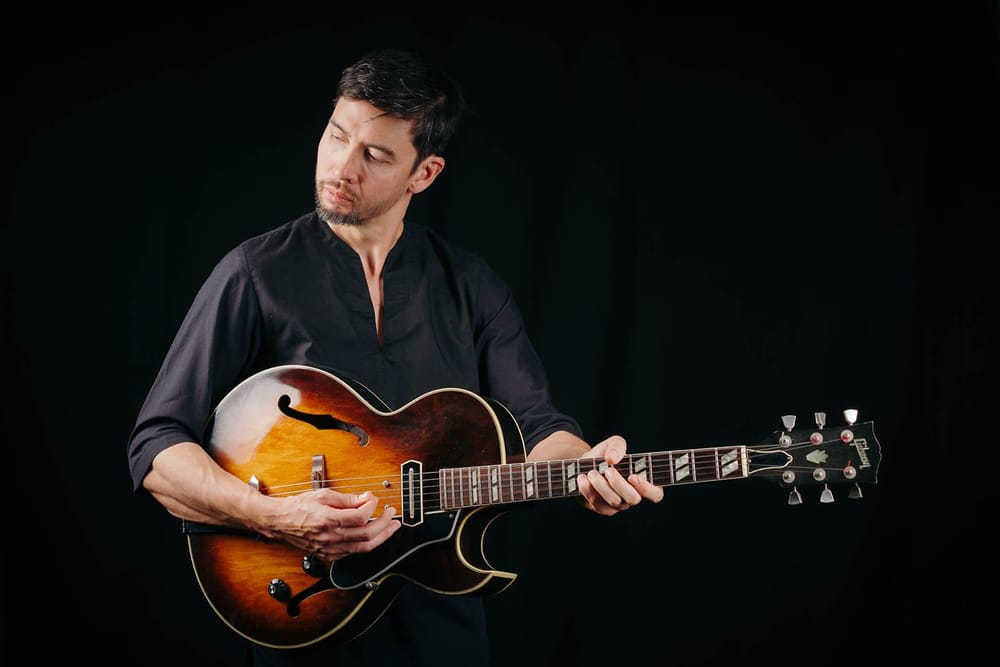
Miles Okazaki is one of the most original voices in modern jazz guitar. Known for his adventurous compositions, deep rhythmic concepts, and highly personal approach to the instrument, he has spent the last two decades carving out a unique path as a guitarist, composer, author, and educator. While his music can be complex and intellectually rich, it's also driven by curiosity, creativity, and a constant desire to discover new possibilities on the guitar.
Born and raised in Port Townsend, Washington, Okazaki began studying classical guitar at age six and was already performing professionally as a teenager. After earning degrees from Harvard University, the Manhattan School of Music, and the Juilliard School, he moved to New York City to pursue a career in music. Since then, he has worked with an impressive range of artists, including Steve Coleman, Kenny Barron, John Zorn, Stanley Turrentine, Jane Monheit, and many others, building a reputation as a fearless and versatile musician.
As a bandleader, Okazaki has released a series of acclaimed albums that blend intricate composition with spontaneous improvisation. One of his most celebrated projects is WORK, a six-volume recording of every composition written by jazz legend Thelonious Monk for solo guitar. The ambitious undertaking earned widespread praise and introduced many listeners to both Monk's music and Okazaki's remarkable musical vision. His ongoing projects, including the innovative quartet Trickster, continue to push the boundaries of what jazz guitar can be.
Beyond performing and recording, Okazaki is a passionate teacher and thinker. He is the author of Fundamentals of Guitar and has taught at leading institutions including the University of Michigan and Princeton University. Whether he's exploring new rhythmic ideas, composing large-scale works, or sharing insights with students, Miles Okazaki approaches music with the same combination of discipline, imagination, and openness that has made him one of today's most respected guitarists.
➡️ We caught up with Miles to dive into his practice habits, Thelonious Monk's influence on his playing & composition style, his favorite gear, and more.
🎸 Q & A
Your book Fundamentals of Guitar represents decades of study. Looking back, what are a few practice ideas that have delivered the biggest long-term results?
The page that I use the most with students is called "The Scrambler." It's just a page full of 12 tone rows, but I use it to randomize practice of all kinds. Like, "play through triads with these roots in one position," and stuff like that. I believe in random processes to open up technique.
What's a practice habit you wish you had adopted earlier in your development?
Practicing with a mirror. This can really help you stay relaxed, develop good posture, and also remind you to stay engaged with those around you instead of looking at your hands.
After spending so much time with Thelonious Monk's music, did it influence your own compositions in unexpected ways? What aspects of Monk's writing do guitarists most often overlook?
I've been looking at Monk's music my whole life, so I don't have a "before and after" type of memory.
All of my compositions are influenced by Monk. Not necessarily in terms of the sound or material, but in terms of the sensibility of creating a personal language that is identifiable. That's a goal that I'm working on.
Guitarists sometimes will go with stock chords on Monk tunes. Like say there's a Bb7 chord, they might add some stuff like a 13th or b9. But Monk had very specific voicings. It makes a difference if you try to learn those, because he took a lot of time to figure them out.
You've adapted drum rudiments and rhythmic systems to the guitar. How has that changed the way you think about right-hand technique?
It's actually always the way I played naturally. It's just that when I tried to describe it, the drum analogy seemed to work pretty well. If you think of the guitar as a pitched drum, then you have these upstrokes and downstrokes that are like the two hands of a drummer.
You don't have any feet, though. This is why on solo shows I'm often tapping my foot as another instrument, to give that context. "This against that" only sounds like something if you have something playing the "that."
Many of your compositions are built around conceptual frameworks. Do compositions usually begin with an idea, a rhythm, a melody, or something else? Do you impose constraints on yourself when composing?
Constraints stimulate creativity, so I would say yes to that last part. If I'm trying to figure out some kind of musical problem, I'll write a tune using that idea. It could be rhythmic, melodic, harmonic, whatever. This is a pretty common technique.
I want to make a musical example, otherwise it's just theory. Then I'll play that tune with people, and if it works, then that's confirmation that I have a solution. If it doesn't work, it's back to the drawing board.
What gear (guitar/amp/pedals) are you using lately—and why?
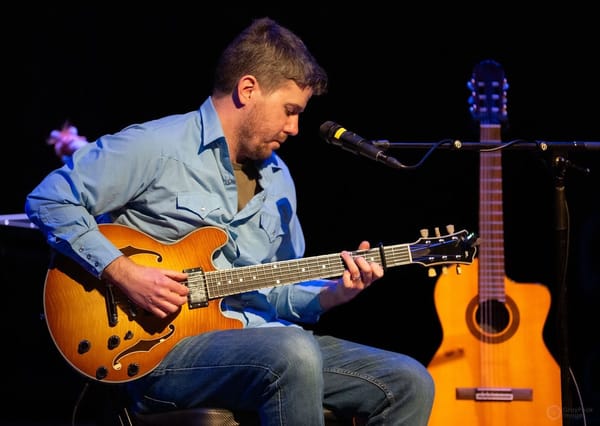
Mostly I play a Gibson ES-150 from 1940 straight into the amp.
I use Quilter amps because they sound great and weigh almost nothing.
In Europe, or somewhere where space is a premium, I'll use a Les Paul style guitar made by Daniel Slaman to sound like an old Charlie Christian guitar and request a Twin or Deluxe for backline.
If I'm playing with my Trickster band or some other group that wants FX, I have a big pedalboard with everything that I use; mostly different fuzzboxes, a POG for octaves, a wah, and a mixing expression pedal.
For years I played a 1978 ES-175 with a Charlie Christian pickup, and I still use that sometimes.
Around NYC, if I can drive, I'll play my 1963 Super 400 with a McCarty pickup.
I have specialty guitars for other projects, 7 string, fretless, microtonal, etc.
And around the house I mostly play nylon string, which is my first instrument.
What’s next for you musically—any projects or goals you're working on?
I have a new record coming out this month on Pi Recordings called BOOMTOWN.
Then there is a concert film about me doing the Monk songbook coming out in October.
Besides that, various projects with friends and colleagues.
My goal is to get a little bit better at playing guitar every day.
⚡ Lightning Round
One album every guitarist should listen to?
Grant Green, Idle Moments
Desert island guitar and amp?
Gibson ES 150, Quilter Aviator Cub
What guitarist should everyone know about?
Emily Remler