Jack Handyside: Exploring Melody, Harmony, and Counterpoint
Jack Handyside emphasizes a purposeful approach to practice, staying curious and focused on what truly inspires him. He also shares how collecting musical “seeds” and exploring counterpoint has expanded his creativity, improvisation, and understanding of harmony.
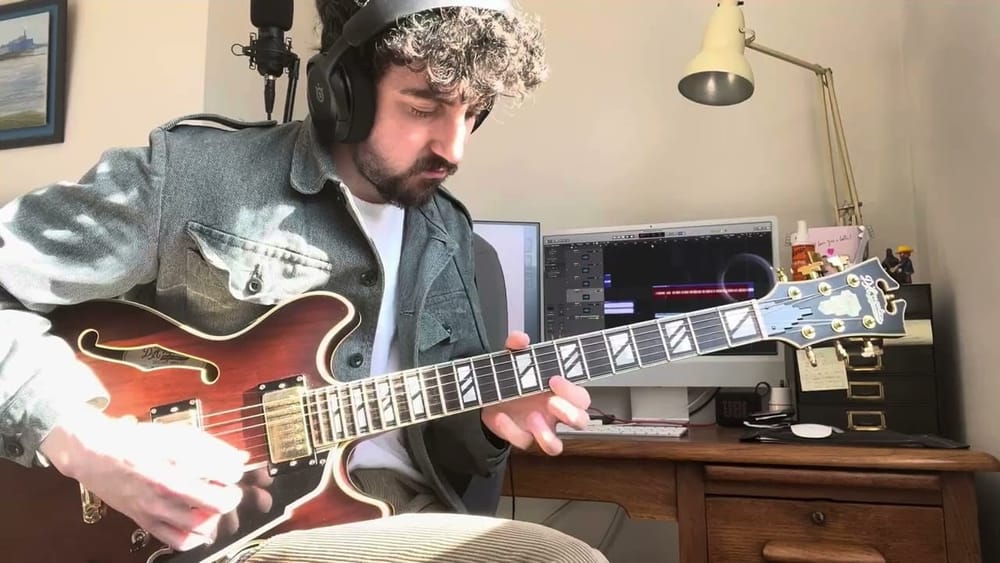
Jack Handyside is a guitarist, composer, and educator based in Birmingham, England. His playing blends jazz, classical, folk, and rock influences, creating a style that is melodic and harmonically rich. He has performed across the UK at venues and festivals including the Cheltenham Jazz Festival, Brick Lane Jazz Festival, Moseley Jazz Festival, and Symphony Hall Birmingham. As both a bandleader and collaborator, he is known for his lyrical melodies and inventive harmonic approach.
Jacj is also an experienced educator, teaching guitarists worldwide through private lessons and online platforms. In 2025, he released The Counterpoint Guitar Method, a book introducing guitarists to counterpoint and voice leading. Drawing inspiration from composers such as Johann Sebastian Bach, the method shows how these ideas can be applied to modern guitar playing, helping musicians create independent melodic lines and richer harmonic textures.
Beyond performing and teaching, Handyside has built a strong presence on Instagram, where he shares short performances, practice tips, and musical insights. His posts highlight creative ways to explore harmony, counterpoint, and melodic development, making complex musical ideas accessible to guitarists at all levels.
➡️ We caught up with Jack, and he shared how purposeful practice, collecting musical “seeds,” and exploring counterpoint have shaped his playing and composing. Whether working on jazz standards, writing new material, or sharing ideas on Instagram, his approach reflects creativity, independence, and a love of music.
🎸 Q & A
What does your typical guitar practice routine look like?
My practice routine is looking a little light these days! Unfortunately, I don't have the same sort of time I used to have during the pandemic to sit and practice. When I do find time to play, I'll often learn a jazz standard from the ground up by learning the melody and chords separately, transposing the piece into a few different keys. The better you know tunes, the easier they are to improvise and reinterpret. There's always something new you can extract from jazz standards that'll keep you busy for a long time.
I'm also at a point in my playing career where I don't need to spend endless hours in a practice room focusing on the same thing or finding something interesting to work on. At some point, your experiences as a working musician will teach you what you're light on. It might be rocking up to jam sessions and not knowing enough tunes to participate, difficulty sight-reading in the studio, or needing more genre-specific vocabulary when playing different styles of music. As long as you continue being inquisitive and accepting new learnings, you'll always find something worth exploring in the practice room.
What is one practice habit or approach that most accelerated your progress—and why did it work?
At some point or another, I realized that it was important to have a connection to the material that I was practicing. If I were going to spend all that time learning a concept, idea, or technique, I felt it was important to know why I was doing it.
Keeping a practice journal has always been a big part of my approach to practice, and it's helped me figure out what I want to express and where my discomforts are. The more honest you are in your practice journaling, the easier it is to see your improvements in the months and years that follow. Journals have always worked incredibly well for me as they help me track my progress over a longer-term period and streamline my approach to learning whenever I find time to play for fun.
But the biggest change to my practice approach was updating my mindset. In the last few years, I've had a bit of a 'mental reset' on what practice is supposed to be. After graduating from music school, my thoughts on practice remained unchanged for quite a while: "play intensely at all possible hours of the day," and "you're never quite good enough".
Eventually, your mind gets tired of being overruled by these two authoritarian statements. Developing who I was as a person had a dramatic effect on the domineering self-talk and relentless practice schedule building I was putting myself through.
Nowadays, my thoughts are more purposeful and relevant to who I actually am: "Do I enjoy what I'm spending time practicing?", or "What sort of feeling or purpose can I extract from this new thing I'm learning?", and "Where could this appear in my soloing/compositional approach?"
What’s your typical process when composing — do you start with harmony, melody, rhythm, or an abstract concept?
Great question! I think what I love about composing is that there is no typical process. You've caught me at an interesting time, where I've recently started my own project. I've been composing quite intensely since the end of last year, trying to write material for my group that's honest and as close to my artistic vision as possible. But I couldn't honestly tell you why some songs start with a melody, or why a particular rhythm feels right to build on.
In Rick Rubin's book, The Creative Act, he introduces the idea of 'collecting seeds'. The concept is about collecting tiny pieces or ideas of interest and storing them until they feel special enough to be explored. Seeds could be anything from a cool drum beat you found, an interesting lick you learned, or a melody that you heard while walking down the street. I love this idea, because I feel like I've been doing it for years without really knowing how or why. The point is to be constantly open to inspiration hitting you and to know that it's all relevant to your creative process.
I don't really have a process, but I try to set aside the first hour of the morning to sit and write out song ideas. Through this, I've learned that you have to allow yourself the opportunity to write a bad song first before a great one appears.
What gear (guitar/amp/pedals) are you using lately—and why?
On gigs, studios, and sessions, I'm mainly using my D'Angelico Deluxe Mini DC.
I've loved the D'Angelico since I bought it 4 years ago. It's the smoothest-playing guitar I have, and it's super versatile. Other than this guitar, I also use a late 80s Made-in-America Fender Stratocaster, a mid-70s Ibanez 2355 archtop, and my favorite instrument, a Fender Made-in-Japan 1985 rosewood telecaster.
Amps and pedals don't change much for me either. I'm still stuck on my Supro Coronado 1690T, and for smaller gigs, the DV Mark Little Jazz.
My board is pretty basic too, with a Source Audio Ventris Reverb, Line 6 HX Stomp, and a Fairfield Circuitry's Shallow Water K-Field Modulator.
Your playing blends jazz, folk, rock, and classical influences. How did your early experiences shape this wide-ranging style, and were there any artists or moments that had a particularly big impact on your direction?
My family have always valued music and the arts as long as I can remember. I grew up listening to everything from Keith Jarrett, Lenny Kravitz, Pink Floyd, Coltrane, and George Clinton.
Classical music has certainly been a major influence on my approach and interests, though. I started taking classical guitar lessons at the age of 8 and continued until I was 18. My education in jazz didn't start until I was around 17. But I remember a few key moments in my early years that really changed my approach and motivation.
Discovering Debussy's music sent me into a bit of a spiral. Back then, my sight reading wasn't quite good enough, so I spent a lot of time transcribing his music by ear onto the guitar. I continued doing this all the way through university with the music of Messiaen, Mendelssohn, Scarlatti, Rachmaninoff, and Ravel. I ended up with a greater fascination with the piano than the guitar - certainly a foreshadowing for my book!
When I was 16/17, I went to see Jonathan Kreisberg at Le Duc des Lombards, which was the first part of a mind-altering experience that propelled me towards jazz.
The second part came a little later when I eventually met my teacher, Hugo Lippi, an incredible jazz guitarist based in Paris.
Perhaps it was simply being in the room with a super high-caliber player and realizing where I was in comparison. But Hugo's lessons shifted something in me permanently, and I'm still grateful for them today. Although I was pretty young at the time and had no real skills to show, I appreciated that he never sugar-coated how much practice or hard work was required.
Despite my youth, he approached me as an inquisitive, real musician determined to improve, rather than a child forced into lessons by a parent. He showed me exactly what was missing from my playing, knowledge, and practice schedule, and how to build myself into a player that might one day be good enough to play professionally. I continue to hold on to many of those teachings for my own practice and approach to teaching my students.
In 2025 you released the book 'The Counterpoint Guitar Method', which focuses on voice‑leading and species counterpoint. What initially drew you to counterpoint, and why do you think it’s such a powerful tool for guitarists?
That was a project I felt very honored to release last year, with my publisher, Fundamental Changes.
I'd been deeply interested in piano harmony for years before the book, and my slight obsession with adapting pianistic chord voicings to the guitar was definitely a catalyst.
In my final year of university, I was deep into Keith Jarrett's trio and solo records, and I was awestruck by how he created incredible worlds of sound from the piano.
I'd been studying pianists for years by that point, but I hadn't ever thought to try to improvise using all of those harmony and independence skills. I knew that one of the things that drew me to Keith's sound and approach was his use of counterpoint.
I had studied a bit of counterpoint, SATB harmonization, and thorough bass in my final years of high school. But the species exercises that most of us are initially taught aren't particularly useful for understanding or writing real music. Using books, university libraries, and score analysis, I went way back to the original Renaissance and Baroque education materials used to teach counterpoint to keyboard players in the 16th and 17th centuries. After taking a few years out to learn the material thoroughly, I started writing some solo guitar music using those principles and eventually improvising them, too.
Truthfully, I spent a lot of time struggling through the Renaissance and Baroque counterpoint materials. Much of the information had to be translated from the keyboard onto the guitar before a method or system for practice even appeared.
The main purpose of the book is to teach guitarists how counterpoint works in the simplest and most actionable way. I didn't want to release a book full of indecipherable rules and conventions on harmony. I wanted to bypass the gatekeeping of this rich and interesting material and make it fun and creative for guitar players to start to explore for themselves. Hopefully, the book achieves that goal.
I think guitarists are often quite interested in counterpoint because it's still rather alien to us. Certainly, many of the rules around dissonance, voice-leading, and consonance are much older than the guitar itself. So, it makes a lot of sense to realize why piano players have a much greater depth of harmony and voice leading than we do.
Instead of the independence enjoyed by pianists who operate with two hands, we only have one hand. This makes independence and polyphony almost immediately more difficult.
For guitarists, using counterpoint introduces a change to your thinking, overall technique, and sense of rhythmic independence. I think it makes you a more meaningful and purposeful player, and one who can operate on different melodic, harmonic, and rhythmic planes. We often forget how young the modern guitar still is as an instrument. There's lots more digging and innovation to be done!
When composing using counterpoint, do you tend to start with one voice and add others, or do you think about multiple voices simultaneously?
Good question! Like my previous answer to composition, it depends entirely on your intent. One thing I've learned about counterpoint through its arduous and endless rules is that you can disregard them and start from anywhere you like. Much of the harmonic and voice-leading innovations during the Baroque era were due to musicians and composers taking risks in their writing and playing. Everyone's favorite, J.S. Bach, was a notorious rule breaker and constantly sought to challenge texture, use of dissonance, and melodic development in his music.
You can start from the bottom, middle, or top line. As long as a melody is convincing, you've got something to work with. If you're learning counterpoint through the strict classical lens, you'll start with the bass line and learn to harmonize, or write strict counterpoint melodies above it.
For other styles of music, the rules around harmony aren't as strict, and you can craft your own rules for harmonizing a good melody. Regardless of style or genre, the most important element of composing music that uses polyphony and counterpoint is to make sure that each voice you introduce doesn't become part of the crowd. The voices need to be distinct, interesting, and clear in their intent. Composing little and often is a good start for learning how to write using polyphony. But digging into your favorite music that uses counterpoint will keep the fire burning for longer.
What do you hope readers of your book take away that they won’t find in other guitar methods?
I hope that readers realize that counterpoint doesn't need to be a stuffy college classroom exercise. It has the potential to completely change your approach to harmony, composition, improvisation, listening, and your relationship to the guitar.
Unlike the complex, jargon-heavy textbooks I had studied when putting the book together, I wanted The Counterpoint Guitar Method to provide guitarists a clear, concise, and creative method for studying the traditional approaches of learning counterpoint. I felt strongly that everyone should have access to learning these important skills.
⚡ Lightning Round
One album every guitarist should listen to?
The Royal Scam - Steely Dan
Desert island guitar and amp?
Nishgaki Style-N and 1964 Fender Deluxe Reverb (Blackface)
What guitarist should everyone know about?
Two! Greg Tuohey and Kazumi Watanabe