
7 Ways to Make Your Guitar Practice More Effective

Do you ever feel like you're practicing guitar a lot, but not making much progress?
While any practice is better than none, there are a few things we can do to make our guitar practice sessions more effective.
In this quick guide, let's take a look at a few ways to get more out of our guitar practice.
1. Focus on One Specific Thing at a Time
If you're trying to get good at too many things, it's hard to get great at any of them.
There's an endless amount of things we want to learn as guitar players. As soon as we get to the top of one peak, there's another even bigger peak ahead of us.
I've found myself getting overwhelmed with guitar on many occasions. We think that in order to be a "good" guitarist, we need to learn how to play every genre of music, from rock and jazz to bluegrass, funk, and more.
We think we need to master every technique, from alternate picking to fingerstyle.
We think we need to know a ton of music theory. Yet plenty of successful musicians have created incredible music without extensive formal training in theory.
We think we have to be experts at reading music. Many highly regarded guitar players, including Jimi Hendrix, never learned to read standard music notation.
You don't need to know everything.
The goal is to play the music in your head on guitar, and to have fun doing it.
Find the style of music you enjoy listening to and playing, and spend more time focusing on it. Enjoy the process of practicing and learning, with the understanding that you will never know everything about guitar. Nobody does.
When you sit down to practice, pick one specific thing you want to improve. It could be a particular chord progression, a technique, or a section of a song you've been struggling with.
You'll often make more progress focusing on one thing than jumping between five different things.
2. Use the Pomodoro Technique
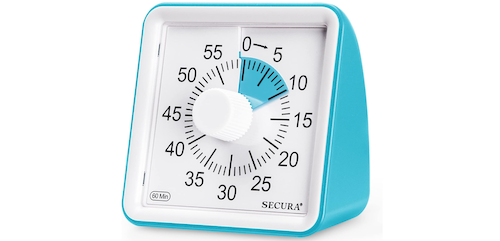
The Pomodoro Technique uses a simple timer to help you manage your time.
First, remove all distractions beforehand. Put your phone in a different room. Turn off notifications on your computer.
Set a timer for 25 minutes, and work on one specific task. After those 25 minutes, take a 5-minute break. Repeat this process as many times as time allows.
When it comes to guitar practice, this can mean working on one specific section of a song, one chord progression, one scale, etc.
25 minutes goes by very quickly when you're not constantly distracted by other things.
And you'd be surprised how much you can accomplish in that time when you're fully focused on what you're doing.
3. Break Things Down Into Small Chunks
We learn best by focusing on small amounts of material at a time.
If you're trying to learn a long or complex song or guitar part, break it into small pieces.
That can be as small as one bar of music, or one short section of a piece.
Get that section down before moving on to the next. Once you're comfortable with each section, start putting them together.
Trying to learn an entire song at once can be overwhelming. Learning a few measures at a time makes the process much more manageable.
4. Be Consistent
Regardless of what you're trying to accomplish, you don't have to be the fastest, smartest, or most talented person to reach your goals. You have to be consistent.
To create long-term habits, you have to figure out how to be consistent. I know that seems overly obvious and simplistic, but how can we do that?
Research suggests that people are more likely to stick with their habits when they make a specific plan for when, where, and how they'll perform a behavior.
When it comes to practicing guitar, our goal should be to come up with a consistent plan where we state the time and place to practice.
For example:
"During the next month, I will practice guitar at 8:00 pm for at least 20 minutes in my bedroom."
Writing this down and putting it on a calendar can also help you stick with the schedule.
I prefer using actual paper and a physical calendar for this type of thing, compared to using an app on my phone. We typically have too many apps on our phones, and too many things fighting for our attention. It's too easy to just ignore the app and never complete the task.
When you first start a new habit, it takes conscious effort to remember to do it. But after a while, the pattern becomes easier and the behavior starts to feel more automatic.
Research has found that habits can take around 66 days on average to become automatic, although the time varies considerably depending on the person and the behavior.
The important thing is to keep showing up.
We all have different schedules. Practicing guitar for a half hour a day is generally more beneficial than cramming 3½ hours into one session each week.
5. Be Productive, Not Busy
There's a difference between being productive and being busy.
Let's say you want to learn how to cook. The best way to learn is to get some recipes, buy some ingredients, and start cooking.
That's productive.
What a lot of people do is first think they need to get some high-end pots, pans, and cooking tools, so they spend time shopping for cooking gear.
Then they read five books about various styles of cooking. Then they watch a bunch of YouTube videos about cooking and follow the top chefs on Instagram.
While those things can be helpful, what they really need to do is just start experimenting with cooking.
All the other stuff makes them feel like they're being productive, when they're really just being busy.
The same thing happens with guitar.
It's easy to spend an hour watching gear reviews, researching scales, or looking for the perfect practice routine without actually picking up your guitar.
There's nothing wrong with any of those things, but they shouldn't replace practicing.
You won't learn how to swim by reading books on swimming. You need to jump in the water.
6. Challenge Yourself
Deliberate practice is important.
Instead of sitting down and playing the same song, chord progression, or guitar solo you've been playing forever, try working on something that's challenging and a bit outside of your comfort zone.
It doesn't have to be something incredibly difficult. Just something you can't quite play yet.
Maybe it's a new chord voicing, a tricky phrase, or playing over a chord progression you're not familiar with.
Spend a little time each day working on something that challenges you.
It's fun to play things we already know, but if we want to improve, we also need to spend time on things we don't know.
7. Take It Slow
Learning guitar is not a race.
A lot of learning guitar involves developing muscle memory, and it's more effective to practice a piece slowly and accurately than to try to play it fast, but sloppily.
If you're struggling with a particular phrase or section of music, slow it down to a tempo where you can play it comfortably.
Once you can play it cleanly, gradually increase the speed.
It might feel like you're making slower progress, but you're building a much stronger foundation.
Lastly, remember that playing guitar is supposed to be fun.
While some people make a living from music and guitar playing, the reason most of us originally picked up a guitar was to have fun and create music.
Enjoy the journey. That's the whole point.