
Guitar Practice
Tim Watson on Rhythm, Improvisation, and Building a Personal Sound
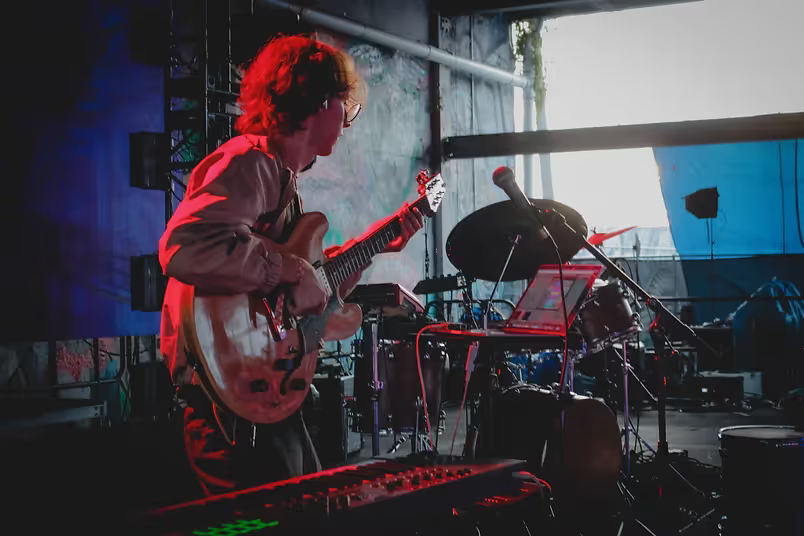
Jazz guitarist Tim Watson has built a body of work defined by an ongoing search for clarity—of sound, of rhythm, and of intent. Based in Brooklyn, Watson moves fluidly between jazz tradition, free improvisation, and electronically mediated performance, appearing at venues such as the Village Vanguard, Apollo Theatre, The Stone, and the Blue Note. His collaborations span a wide range of contemporary voices, including Marcus Gilmore, Joel Ross, Immanuel Wilkins, Emmanuel Michael, and members of groups like Flanafi and My trio, reflecting a musical life rooted as much in community as in individual expression.
Watson’s path to jazz began outside the tradition, shaped early by rock and metal, where intensity and complex rhythm first captured his attention. That background continues to inform his playing, now filtered through bebop study, free improvisation, and deep rhythmic investigation. In recent years, his exposure to South Indian Carnatic music—studying and performing in Chennai—has further expanded his sense of time and form, influencing both his compositions and improvisational approach. Whether working within strict structures or open contexts, Watson treats rhythm as an active, evolving discipline rather than a solved problem.
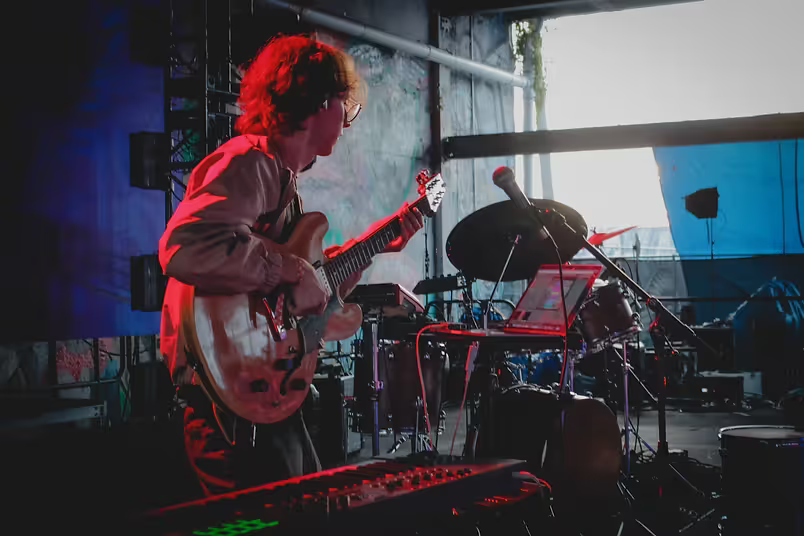
Equally committed to sound exploration, Watson has increasingly embraced laptop-based performance, favoring direct-input guitar tones and real-time processing over traditional amp-and-pedal setups. As a teacher and mentor, he emphasizes foundational feel, listening, and musical honesty over abstract complexity—an outlook that mirrors his own practice. For Watson, progress isn’t about mastery as much as maintenance: returning to the pocket, revisiting bebop language, and staying open to the next way the music might change him.
We caught up with Tim to talk shop about guitar practice, his background, his thoughts on gear, and much more.
🎸 Q & A
What does your current guitar practice routine look like?
I have a hard time staying consistent with any sort of routine. The one thing I'm always working on is sound design in one way or another. It's feels like one of the only things in music that comes naturally to me and I consistently have a blast doing it. These days I'm working on making Ableton DI tones that have an over the top 80's DX vibe. I'm messing around a little bit with midi guitar 2 as well.
Other than that, I try to alternate between working on my weaknesses and intensifying my strengths. Right now I'm trying to develop my rhythm guitar playing (something I neglected for a long time), so I'm doing a lot of very slow strumming work with the metronome and playing along to Prince and Sly and the Family Stone; stuff like that.
I'm also working on playing proper free improvised music so I'm attempting to rip off Derek Bailey, and trying to integrate that harmonic and rhythmic language into my jazz playing. I've also been working on short super intense mixed meter forms (ala Christian Lillenger) and trying to play freely inside of those structures.
Your background includes playing rock and metal in your youth before diving into jazz — how did that transition shape your approach to the instrument?
Some of my favorite metal bands as a kid have stayed with me. Meshuggah is still probably my favorite band of all time. When I lived in Miami I drove 5 hours by myself to see them play in Orlando and it was one of the most incredible things I've ever witnessed. I think being so obsessed with music that's as intense as metal made me want to play guitar as expressively as I could. Prog metal was also my first rhythmic obsession.
In addition to playing, you also teach guitar. What’s a misconception you often encounter about improvisation or jazz theory that you wish more students understood early on?
This is a classic jazz education thing to say, but when I was teaching more I always had students that were obsessed with advanced harmonic concepts but weren't able to play in the pocket or lay down some solid bebop. It's something I can totally relate to.
I have to deal with rhythm every day or else my feel degrades rapidly - its not something thats in my blood at all. And I periodically try to do a check up on my bebop playing and learn a little more Charlie Parker or Lennie Tristano, to make sure I still have a solid foundation and can express chords accurately.
What gear (guitar/amp/pedals) are you using lately—and why?
I'm experimenting with no amps or pedals these days, just a cheap tele straight into my Universal Audio Apollo Twin running a ton of stereo FX in Ableton live.
I recently had a huge realization that my extensive pedalboard that I've been using for years has been messing up the high end clarity of my tone pretty substantially, so I'm trying no pedals for now. And for the past couple years I've been using a lot of patches that produce considerable sub frequencies so normal guitar amps are out of the question.
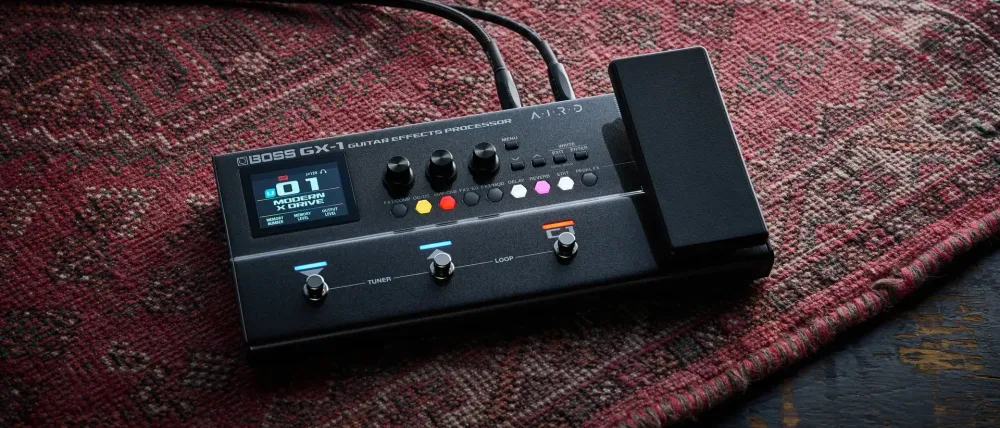
I recently did my first tour with this setup, using a midi foot controller to switch guitar patches on my laptop and the fidelity of my tones was really satisfying. That being said, I love the feeling of being extremely nimble with a pedalboard and morphing my tone drastically over the course of a song, adding granular fx for transitions and whatnot, and the DI/midi setup that I've built doesn't lend itself to that. Eventually I think the ideal solution would be to do a setup with just my HX stomp, Red Panda tensor, and Chase Bliss mood, and then go into my laptop to get the best of both worlds.
You’ve performed in Chennai with leading Carnatic musicians — how has studying and performing South Indian classical music influenced your sense of rhythm and composition?
It's definitely opened my eyes to a number of different ways to manipulate rhythm that we barely even scratch the surface of in western music. I used an accelerating rhythmic cycle my teacher Anantha R. Krishnan showed me as the intro and outro to my song Adrenochrome Etude, and have periodically experimented with Carnatic rhythmic ideas in pieces since then. And although I've never studied the melodic aspects of Carnatic music in any serious way, I sometimes try to improvise with lots of melodic embellishments to loosely imitate my favorite Carnatic singers like Abishek Raghuram and Ranjani–Gayatri.
Looking back at your journey so far, what advice would you give your younger self when you first picked up the guitar?
I would probably tell myself to give the music theory a rest and play along to some amazing records!
You’ve played at iconic venues like the Village Vanguard and the Apollo Theatre. What’s your approach to preparing for these different kinds of performance spaces?
Ideally the venue doesn't effect your mental state and you just go into it trying to play the music well, but I'll be the first person to say the one night I played at the Vanguard I was scared shitless. I just tried to warm up really well (I try to warm up everything, my chops, my ears, my rhythmic brain, harmonic brain, even my heart) so I could do my best.
What’s next for you — any upcoming projects, recordings, or artistic goals you’re excited to share?
I'm working on a duo album with Emmanuel Michael, one live album and one studio album with the band My trio (with Yvonne Rogers and Jon Starks), and writing for my group with Dion Kerr and Craig Weinrib that plays my guitar trio music.
⚡ Lightning Round
One album every guitarist should listen to?
Solstice-Ralph Towner
Desert island guitar and amp?
I'm searching for that! but for now my answer is a solid stratocaster and a huge PA system.
What guitarist should everyone know about?
Simon Martinez/Flanafi
RIP Bob Weir
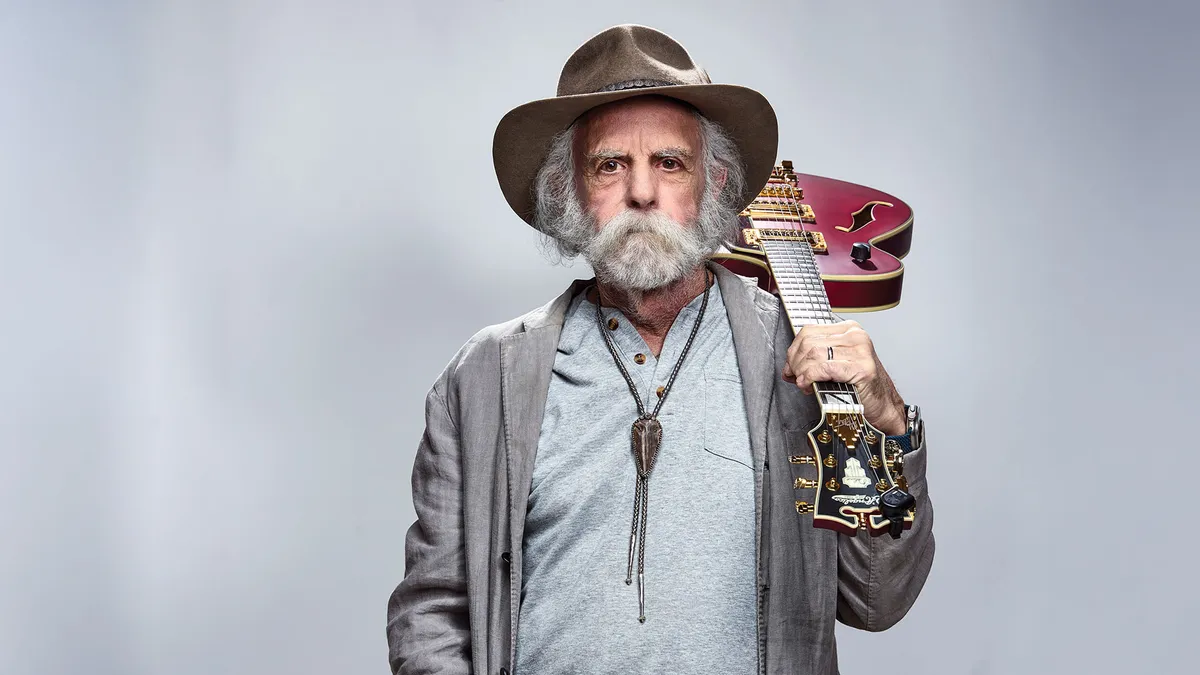
Bob Weir, legendary guitarist, singer, and songwriter best known as a founding member of the Grateful Dead, passed away age age 78.
The announcement, made on Saturday evening (January 10), says: “It is with profound sadness that we share the passing of Bobby Weir. He transitioned peacefully, surrounded by loved ones, after courageously beating cancer as only Bobby could. Unfortunately, he succumbed to underlying lung issues.”
Co-founding the Grateful Dead (previously The Warlocks, before changing the name) in the mid-1960s, Weir developed a highly distinctive rhythm guitar style that blended folk, blues, jazz, and experimental rock, helping shape the Dead’s improvisational sound. His thoughtful chord voicings and willingness to play against traditional guitar roles made him an essential part of the band’s musical identity. Beyond the Grateful Dead, Weir continued to carry on the Grateful Dead's legacy through projects like RatDog, Further, Bob Weir & The Wolf Bros, and Dead & Company, continuing to push live music toward exploration and spontaneity.
Fare thee well Bobby. You sure did enjoy the ride.
News & Notes 🗞️
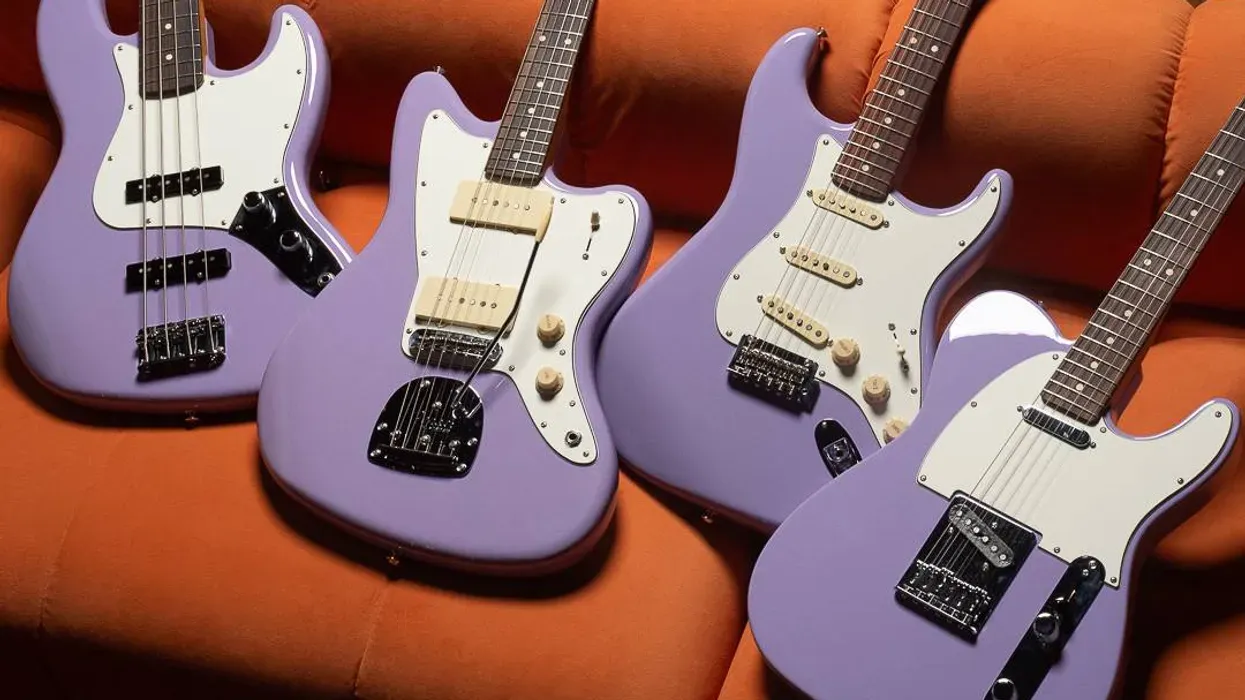
- Fender released Player II collection in a Lavender Haze color, esclusive to Chicago Music Exchange (in the U.S.) and Andertons Music (in the U.K.). The lineup features the Jazzmaster®, Stratocaster®, Telecaster®, and Jazz Bass® – each finished in a never-before-seen Lavender Haze color and equipped with all-new proprietary Fender “Full Dip” pickups.
- In other Fender news, the company announced that current CEO Andy Mooney is retiring in February 2026 after a decade leading the company, and Bud Cole has been named the new CEO.
- Ibanez announced their 2026 guitar lineup. We especially dig the new semi-hollow Artstar models: The AM153FM, the ASH300, and AF115 archtop.
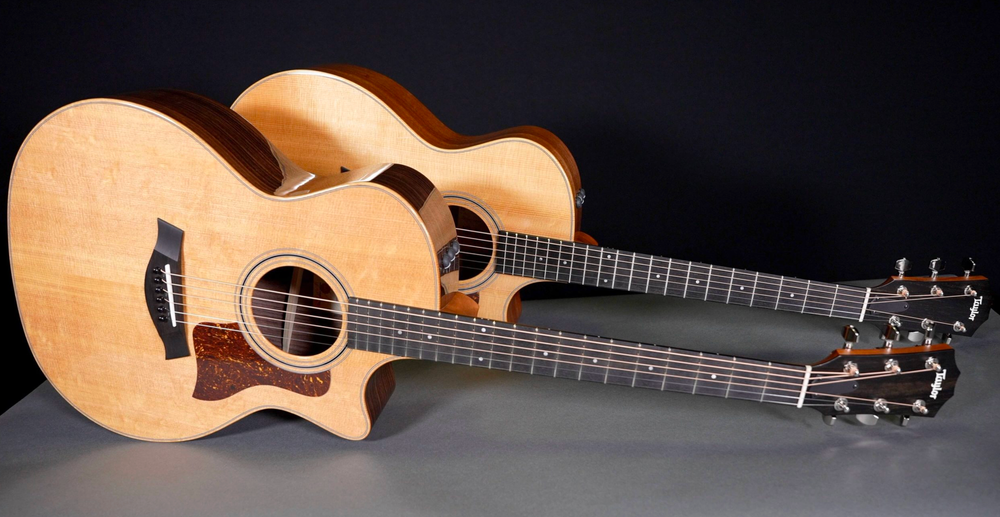
- New for 2026, Taylor Guitars introduced a new line of acoustic guitars they're calling 'Next-Generation' models. The lineup features Grand Auditorium and Gold Label Dreadnaught guitars - including revamped versions of their 814ce, 314ce, 414ce, 234ce, and other models. Key features include scalloped V-class bracing, Taylor's trademarked Action Control necks, and a Claria™ pickup system.
- Rivolta Guitars announced 2 new guitars models: The Mondata CC (an offset guitar with a 25" scale, alico 5 mini-humbuckers) and the Combinata Classico P90 (which is a P90-equipped version of their standard Combinata Classico model).
Enjoy this newsletter? Please forward to a friend or hit reply to share your thoughts.🤘