

Was this email forwarded to you? Subscribe here!
💬
"If you play without understanding where chord changes happen, you'll likely guess and get lost. If you don't understand the rhythm or chords behind a solo, your playing will sound mechanical - just vertical scales up and down, like an exercise." - Tomo Fujita
The Art of Improvisation
We have a bit of a different issue this week.
There was a post in the Telecaster Group on Facebook with a great asking about people's thought process when improvising.
While some posts in groups on social media can end up with a cesspool of responses, this one ended up some so many incredible posts, I wanted to share it here. The comment thread is pure gold when it comes to improvising on guitar. I curated the best answers, and they're posted below.
The question:
For those here who are experiencing and able to improvise effortlessly, what’s your thought process when you’re playing a solo or a lick and making it up as you go? How do you make your stuff sound musical and not like you’re just playing a scale?
The answers (from various different guitar players):
- Play the chord changes and use lots of chord tones.
- Music is a language. Use short phrases and build from there.
- Try to hum the lines you want to play and play along to it. It will sound more musical and less mechanical that way. Singing your melody forces a more lyrical sense of phrasing, as you’ve got to take a breath every so often. Knowing your scales/arpeggios/chord tones etc. are all important too, as it gives you the tools to do this, but the focus isn’t in the tool at hand, the focus is on ideas. Melodic ideas.
- Try to solo like a vocal melody. The notes aren't nearly as important as the timing, the cadence, the feel.. Think of it like a good verse of a lead vocal.
- For me, you have to get to the point where when you hear it in your head you know where it is. I got there by practicing both scales and modes, sometimes by just running up and down exercises, sometimes by just noodling around in a particular one. After awhile it becomes almost a subconscious thing. You are thinking about the sounds and your hands just automatically know how to make them. The only way to get there is to practice. Play your guitar.
- I would suggest that knowing how to play chords all over the guitar neck is the most important thing. You may be playing scales, but in order for it to make sense and be musical, the notes of the chord that's playing under the solo should be the main/foundational notes of your licks. Improvising is a skill like any other. Just keep doing it and you'll get better at it!
- For starters, don't spend too much time learning scales (or you will sound like you're playing scales). Build up a palette of tasteful licks & phrases based around patterns on the fingerboard. Keep adding to your palette, utilize octaves of the same patterns, and use notes found within the chords to make melodic lines & patterns. Try to put feeling into each & every note.
- The best advice I heard was that an on-the-spot solo is just a conversation between yourself and your guitar. Just talk with it.
- Essentially you are asking your hands to do what your mind comes up with.Just as with speaking, a good vocabulary helps a lot. These are the musical ideas that you gain from listening and practice. In order for the gap between the mind and the hands to shorten, you should listen a lot, improve your guitar chops, and practice playing what you hear in your head. Sing what you play.
- It's important to be able to play scales, arpeggios, etc., but only to be able to draw from them when the time is right. I try to be melodic, like the guitar is singing a melody over the band. And sometimes less is more.
- Play, play & play. The more you play & experiment the quicker it will come. Jam with someone if you can. Learn from them. Find positions that work. Expand what you learn & ask questions if you find someone willing to help & encourage you.
- Steal phrases you like from other people , just short licks. Play with them, change them and you'll have an inventory of words to play with rather than single letters.
- You need to jam! Preferably with other players, but you can also jam with backing tracks or a looper. I generally play with a looper. It took me years of practice to sound " musical"You need to learn slurs: Hammer ons, pull offs, bends, slides etc. Learning scales is like learning your ABC useful, but it's only the starting point for creative writing.
- Play along with things you're less familiar with (a playlist or the radio maybe) and find the lowest common denominator - the root note, the chord, the key it's in and play what fits. Try to get to the point where you can repeat riffs and phrases you hear in real time. Any riff or phrase you learn, find everywhere you can play it on the neck, in every octave, maybe in every key. Then when it comes time to play along with other musicians or a backing track, play what isn't already there. Play what's missing. Play what brings the other parts together.
- Steal licks from your favorite guitarists, put your own little spin on it, listen to the different styles of guitar players and you'll get ideas about using vibrato, legato, hammer-ons, pulls offs, multi-step bends, smear licks. The idea when improvising, at least in my opinion: is to play what you'd want to hear played.
- I pretend I am speaking. I leave gaps for you to digest what I just said ... or for you to reply. When I'm playing rhythm behind the vocals I tend to pull the chords with my fingers and try and create a groove rather than simply strumming.
- Learn to play the melody, then embellish from there. Otherwise, just running licks together can sound like wanking or running scales. Playing with the melody will inherently help your phrasing.
- It takes a lot of playing time (years). It's one thing to know all the scales, triads, theory etc... but to have this stuff so ingrained in your being that you don't have to think about it, and be able to play freely, takes time. One thing I tell myself is to take breaths when improvising. It helps to let a phrase sit before answering it or building on it.
- An important aspect to concentrate upon is your picking hand technique. It controls the dynamics and the rhythm of play. Learning to fit triplets, quadruplets and quintuplets into the backing rhythm is very helpful.
- It's all about phrasing, most solos are a call and response. Don't think about what you're playing think about what you're going to play next. You don't think about what you said in a conversation (during it); you just respond. Music is a language and improvisation is just a conversation that isn't predetermined.
- Try to play the song melody including timing/phrasing to begin. Even if you hit the wrong notes, but are in the right key for the song, sometimes you are close, sometimes you hit a cool harmony to the melody by accident. Sometimes it doesn’t sound right. If the first try doesn’t sound right, move to a different starting note in the same scale and try it again. You will get in the ballpark. In effect, try to find the correct first note of the melody, and the rest of the melody is usually close to that area.
- The chords. The chord changes, the root pentatonic, major or minor, and where it resolves. Get it connected to the beat. That's the brain for me.
- Can you whistle a tune? When your fingers can react intuitively to find intervals that your mind is generating, you'll start to be a player.
- Don't play scales. Sing a melody to the changes, then play it. My mind just keeps anticipating the changes, and then sings along. My fingers just mirror what's in my head.The music is in your head/heart, not in your fingers. But it's definitely not a "thought process," either. I'm just listening, anticipating and responding.
- I play to the chord changes. Originally I focused on the chord root. I would make key points of my phrase land on the root. Now, I pay more attention to the chord's 3rd. I also try to work in notes that are common to both chords - or even better, notes that are a half step apart. There can also be arpeggios that sound fantastic when played over a different chord, like a Gmaj7 or Cmaj7 over an Am7. I also LOVE double stops.
- The best thing is to play to the melody. It's great running scales, but making your playing stay with the melody of the song is best in my opinion.
- Practice soloing over a backing track. Something simple where the chord structure keeps repeating. Try ending your licks on different chord notes, not just the root. Try bends and slides to get to the next note.
- I would recommend approaching it like this - first, be able to play the melody to the song. Then, here’s where it gets fun. In your head, any time of day, even if you’re not with your instrument, think about any and all variations of the melody. Different rhythms, approach notes, really anything. Then, when you get back to your instrument, see if you can get those ideas out of your head and on to the fretboard. At the end of the day, improvising is like talking - you’re not giving a pre-written speech, you’re just using your vocabulary, grammar, and syntax off the cuff. So, take those ideas that you hear in your head and try your best to make the translation seem less to your instrument. It will show you all sorts of new exercises to work on, and you’ll be playing things that you never thought you would. Also, and here’s the really important part - be patient with yourself. Don’t force it. Make up little exercises and practice them every day - even if it’s just five or ten minutes. Eventually, you will be thinking about the mechanics less and less and playing what is in your head. Remember, we all had to learn to use our lungs, lips, and tongue in order to speak. Same idea. And, the most important part of improvising - don’t overthink it. Let it be natural. And, if you mess up, just laugh and move on to the next thing. What you play next is almost always more important to give everything context. Sometimes, a mistake may lead you somewhere cooler than what you had planned! Oh yeah, don’t forget to breathe! Enjoy! And, listen to your band!
News & Notes 🗞️
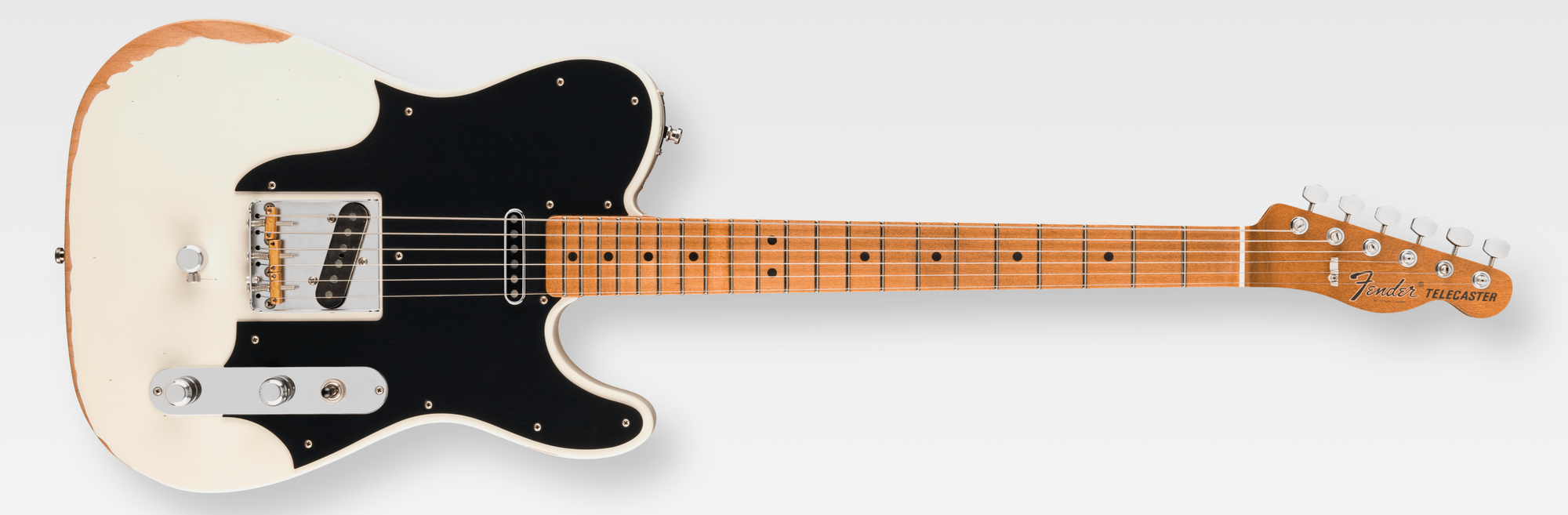
- Fender released a John Osborne Telecaster®. The guitar features a B-bender, and alder body with Road Worn® nitrocellulose lacquer finish in Olympic White, a "C"-shape Maple Neck with Maple Cap Fingerboard, and custom-voiced John Osborne telecaster pickups.
- In other Fender news, the company won a big lawsuit that protects the Stratocaster body design. While the ruling is specific to Germany and other countries of the European Union, it could have implications for various companies that make their own S-style guitar models.
- Martin Guitar announced Project 91, which is a limited collection of 91 Martin guitars, each inspired by a specific pre-war D-45 dreadnought model serial number.
- Tommy Emmanuel joined the Broken Record podcast.Tommy talked about his unique fingerstyle technique and how he developed the ability to make one guitar sound like multiple instruments. He tells the story of opening for Stevie Wonder in 1980 and walking in on him jamming with an early LinnDrum machine. And Tommy plays examples of his songs throughout the years, demonstrating his remarkable approach to the acoustic guitar. Apple Podcasts | Spotify
- David Gilmour's black Stratocaster sold for $14.5million at an auction, making it the most expensive guitar ever sold. Jerry Garcia's Alembic Guitars Tiger guitar sold for just under $12m, to Family Guitars. Family Guitars is co-founded by Chicagoan Bobby Tseitlin, and focuses on letting historic guitars continue to be played and experienced, rather than displayed behind glass. Watch Derek Trucks play Jerry's Tiger the day after it was acquired.
- Mark from guitar retailer Gary's Guitars gave his take on the current state of the used guitar market. His key points:
- He correctly predicted a reduction of around 20% in the price of used guitars last year, and thinks the same thing will continue this year.
- People are gravitating toward smaller and lighter amps.
- Mid-range, unremarkable guitars are struggling to sell, as there are so many of them on the market. Guitars have to be special to sell - think vintage guitars, or limited run models.
Enjoy this newsletter? Please forward to a friend or hit reply to share your thoughts.🤘