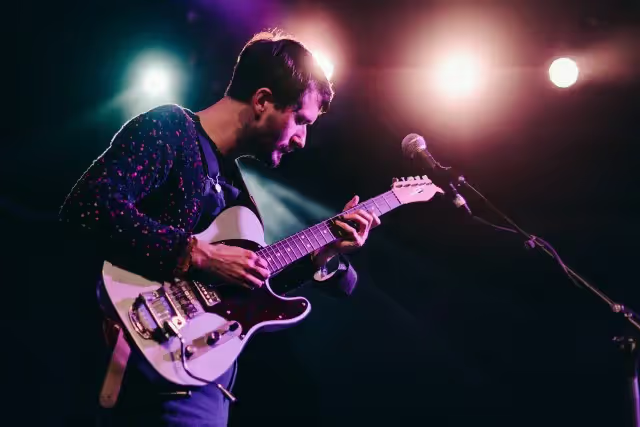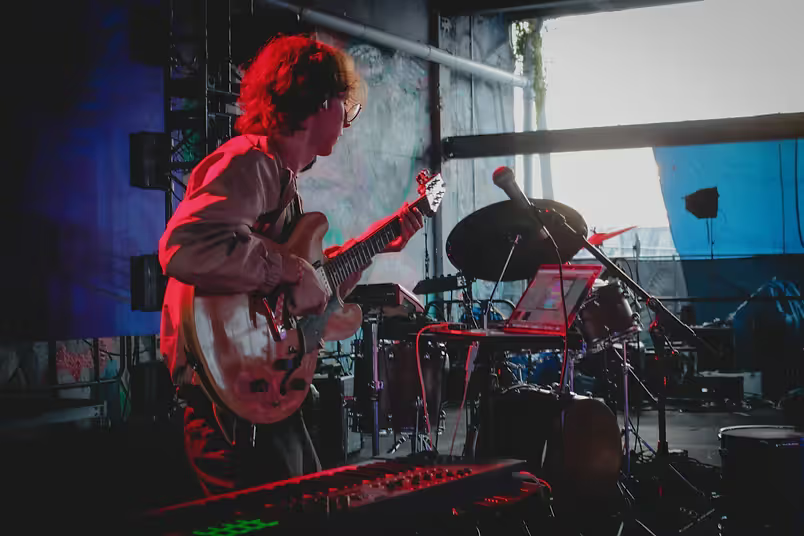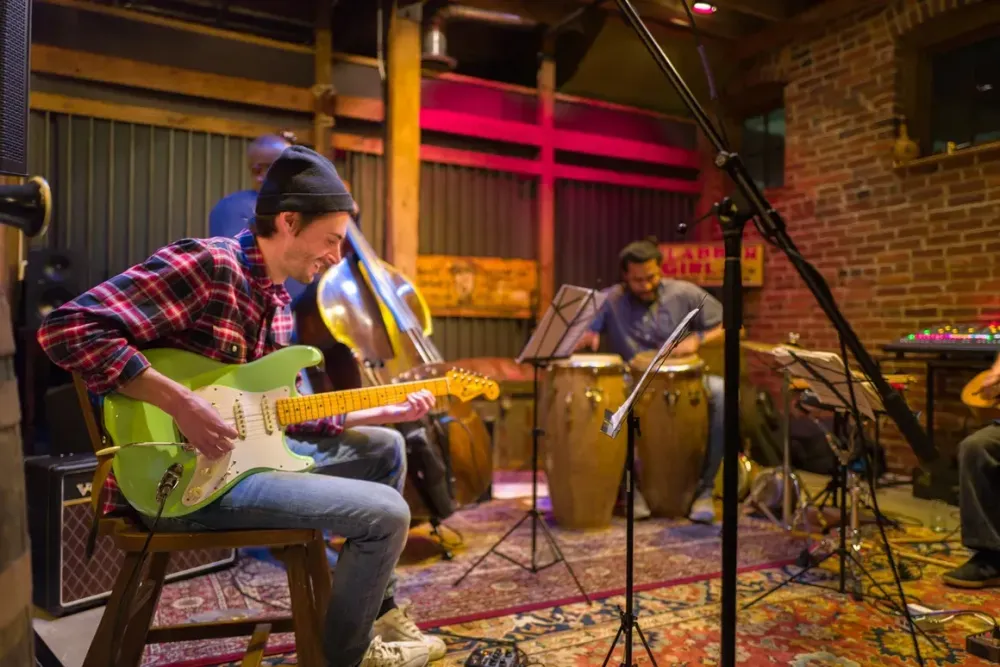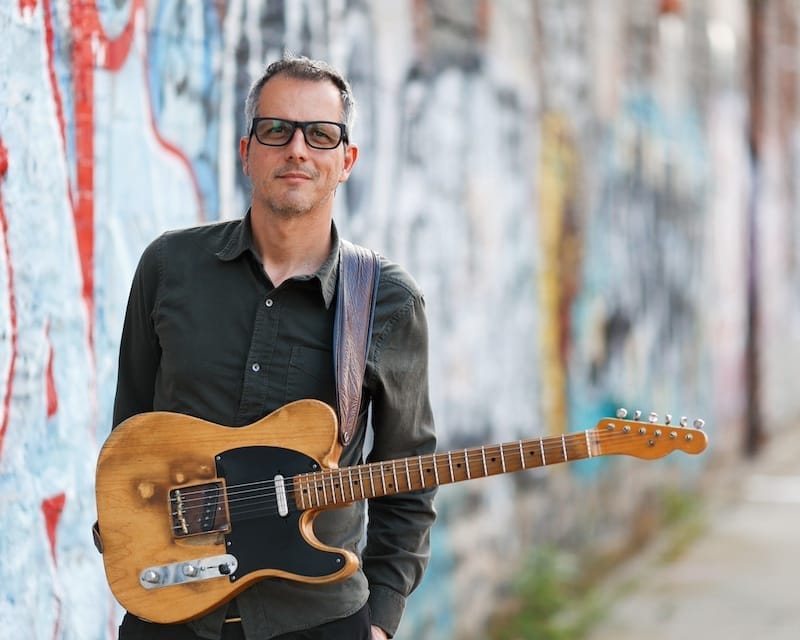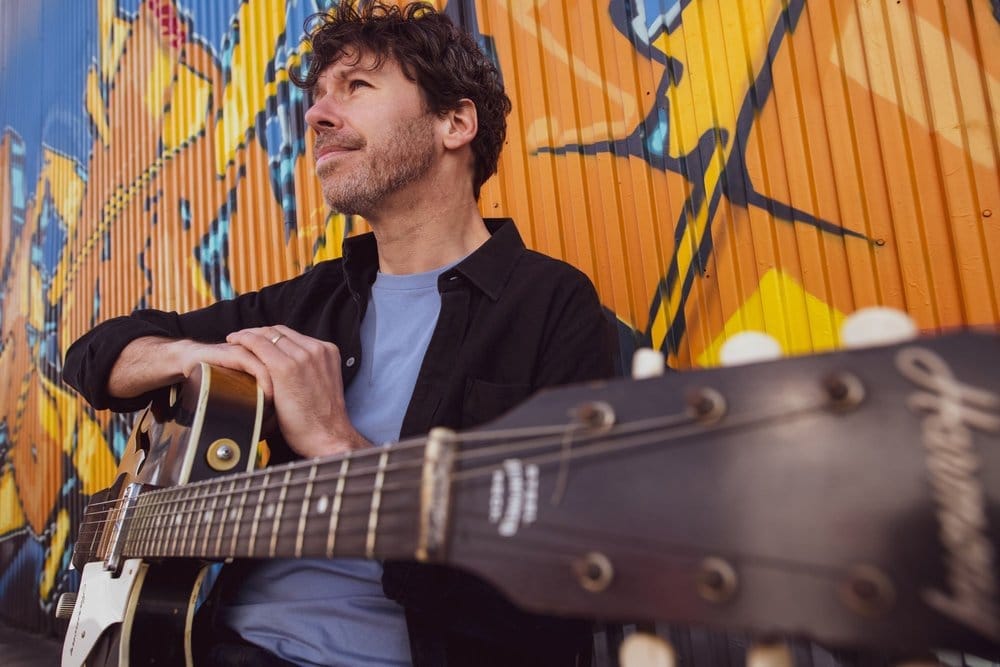
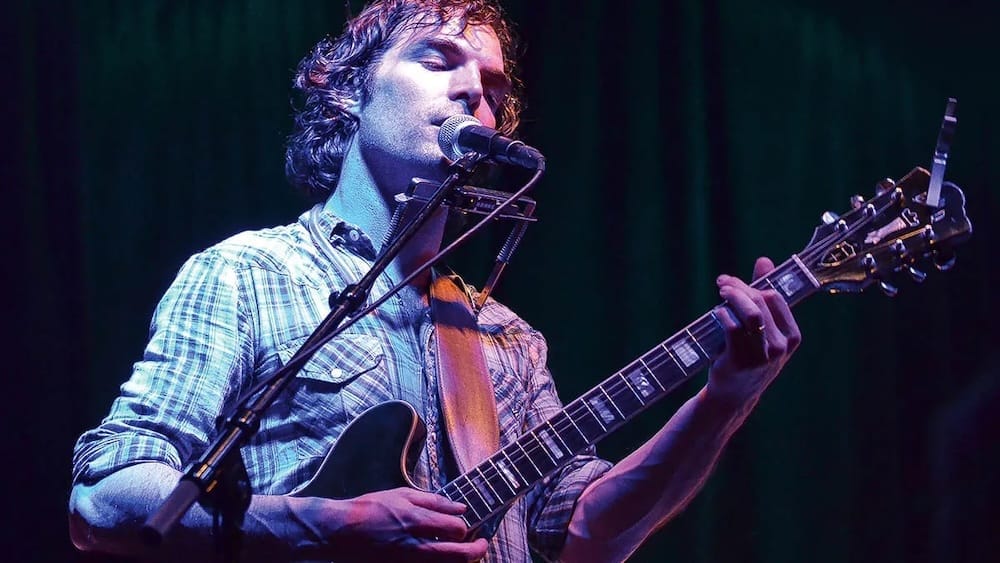
Brad Barr is a thoughtful and deeply expressive guitarist whose playing is instantly recognizable once you hear it. He’s best known as the creative force behind The Barr Brothers and as a founding member of The Slip. Over the past 25+ years, Brad has built a sound that blends folk, blues, jazz, and indie rock into something that feels completely his own. His finger-picking style can be hypnotic, and his singing has a raw, honest quality that pulls you in.
Brad grew up in Rhode Island and started making music early on with his brother Andrew, who plays drums. In the 1990s, they formed The Slip. The band mixed jazz, rock, and improvisation, and they became known for adventurous live shows. Albums like From the Gecko (1997), Does (2000), and Eisenhower (2006) show how wide their musical range really was—from jam-heavy tracks to tighter, indie-style songs. Brad and The Slip also joined forces with singer-songwriter Nathan Moore under the name Surprise Me Mr. Davis, which combined Moore’s folk sensibilities with The Slip’s adventurous grooves.
Later, Brad made a big move to Montreal. There, he and Andrew teamed up with harpist Sarah Pagé to start The Barr Brothers. The harp added a whole new texture to the music, giving it a rich, cinematic feel. Songs like “Beggar in the Morning” and “Even the Darkness Has Arms” helped the band reach a wider audience. The music feels both powerful and personal, with thoughtful lyrics and detailed guitar work at the center. The Barr Brothers' newest album, Let It Hiss, captures a more introspective and emotionally honest side of their folk-rock sound. It's a truly outstanding album.
Brad has also released solo albums, including The Fall Apartment (2008) and The Winter Mission (2022). You can hear hints of his influences in his playing, from John McLaughlin and Wes Montgomery to Bill Frisell, Angus Young, Grateful Dead, and The Allman Brothers Band.
➡️ We caught up with Brad, and in the below Q&A, he hares the habits and routines that keep his playing grounded and evolving, from disciplined practice to tone obsession. He reflects on lyrical growth, improvisation, and why Let It Hiss merges The Barr Brothers’ songwriting with The Slip’s explosive spirit—plus the advice he’d give his younger self.
🎸 Q & A
What does your current guitar practice routine look like?
I like to use a drone app to get myself going, the Dhwani Tanpura app specifically.
Usually I’ll start by singing along with it first; very simple pentatonic sounds. I find this helps connect me to what I’m about to practice; connects my playing to my breath.
Then I’ll spend a few minutes slowly improvising on the guitar in whatever mode or scale I started singing in. After that, I like to work the muscles with chromatic exercises, varying the number of note groupings.
I also like to practice using “cells”, or 3-note structures composed of two intervals (ie, a 2nd and a 4th) and move their inversions, eventually bringing in some chromatic shifts (up a half-step). I like playing over be-bop changes too. Hope that makes sense!
What’s one technique, habit, or concept that helped you level up as a guitar player?
Three things:
1) Remembering to breath
2) Really being in love with my tone and the way my guitar feels, and
3) Transcribing Hank Mobley solos
You’ve balanced instrumental guitar music with song-based writing for years. How do you decide when a piece wants to stay instrumental versus becoming a song with lyrics?
Great question. It’s usually a matter of: does the guitar want to fill up most of the space? Or does the part I’ve come up with leave room for the voice? Most of the time I’m looking for a lyric, or at least …I’m open to words presenting themselves.
For a long time, I’d write very intricate and complex instrumental songs, and the songs with words were, by contrast, really simple forms. I’ve been trying to find a middle ground lately.
Also, lyric-based songs usually start as chord voicings, where instrumental songs usually start as finger-style motifs.
Your finger-style approach has a fluid, almost pianistic quality. How did that technique develop? Was it intentional or something that happened naturally over time?
Thank you. I think it was born out of playing and touring as a trio (The Slip) for so long. In this trio, the guitar had to cover a lot of ground melodically and harmonically, often at the same time.
That lead me to a way of playing where I end up deconstructing the chords (dyads and triads, etc.) and finding the moving parts within them.
How has your writing process evolved from your early days with The Slip to The Barr Brothers, and your solo work?
I’m definitely more focused on writing stronger lyrics these days. With The Slip, lyrics were often an afterthought, and I was far less picky about them as long as they gave way to some fun instrumental passages. Now I try to make sure that the lyrical theme is in place before I move forward.
Sometimes this takes a while…I’ve sat on ideas for years, sometimes just a single word, as long as there’s a lyric that grounds me to the music and points in a direction. I do think that with the latest record, Let It Hiss, we came the closest to capturing the lyrical integrity of The Barr Brothers and the musical explosions of The Slip.
What gear (guitar/amp/pedals) are you using lately—and why?
It’s gotten pretty extensive, actually.
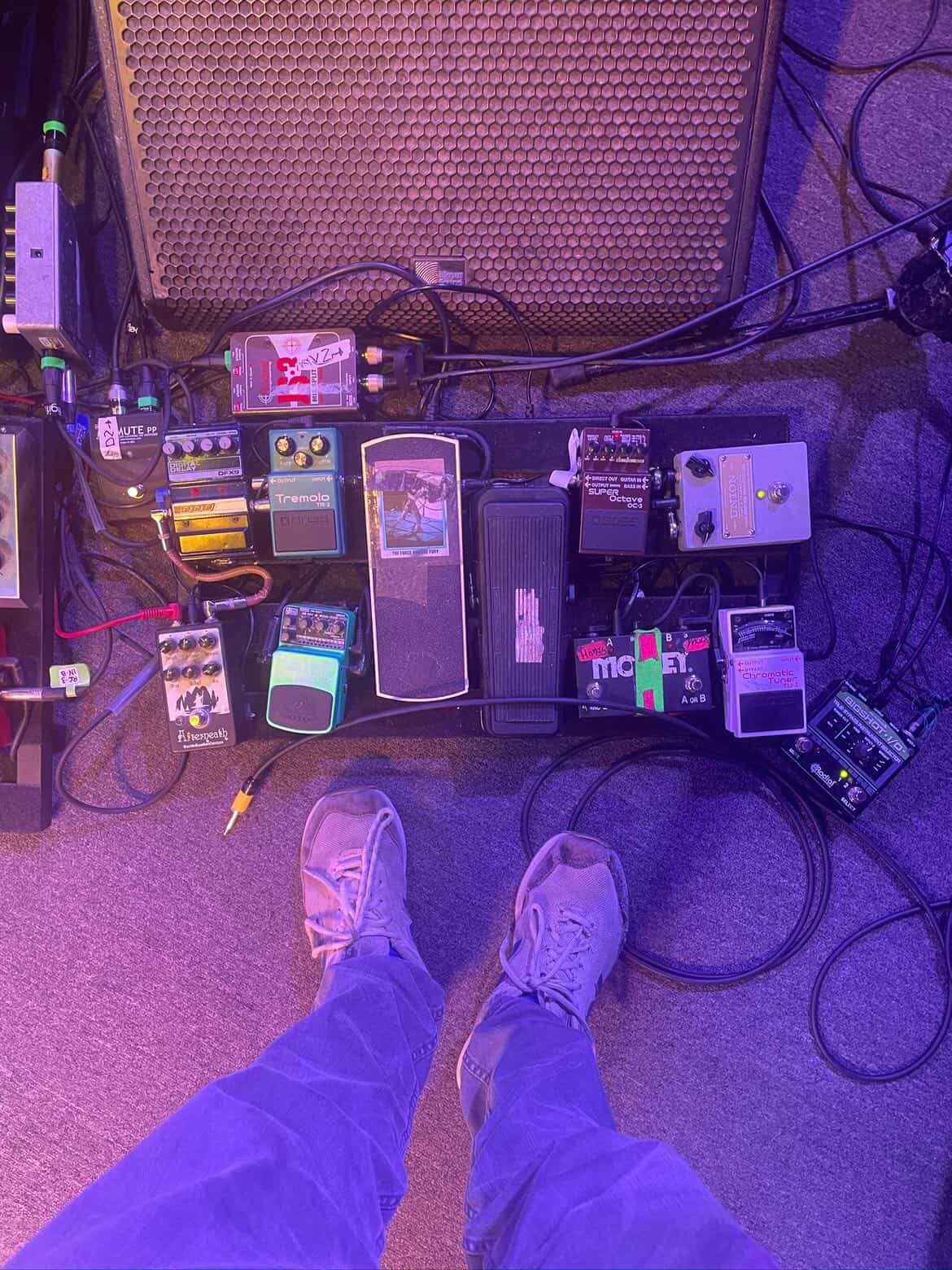
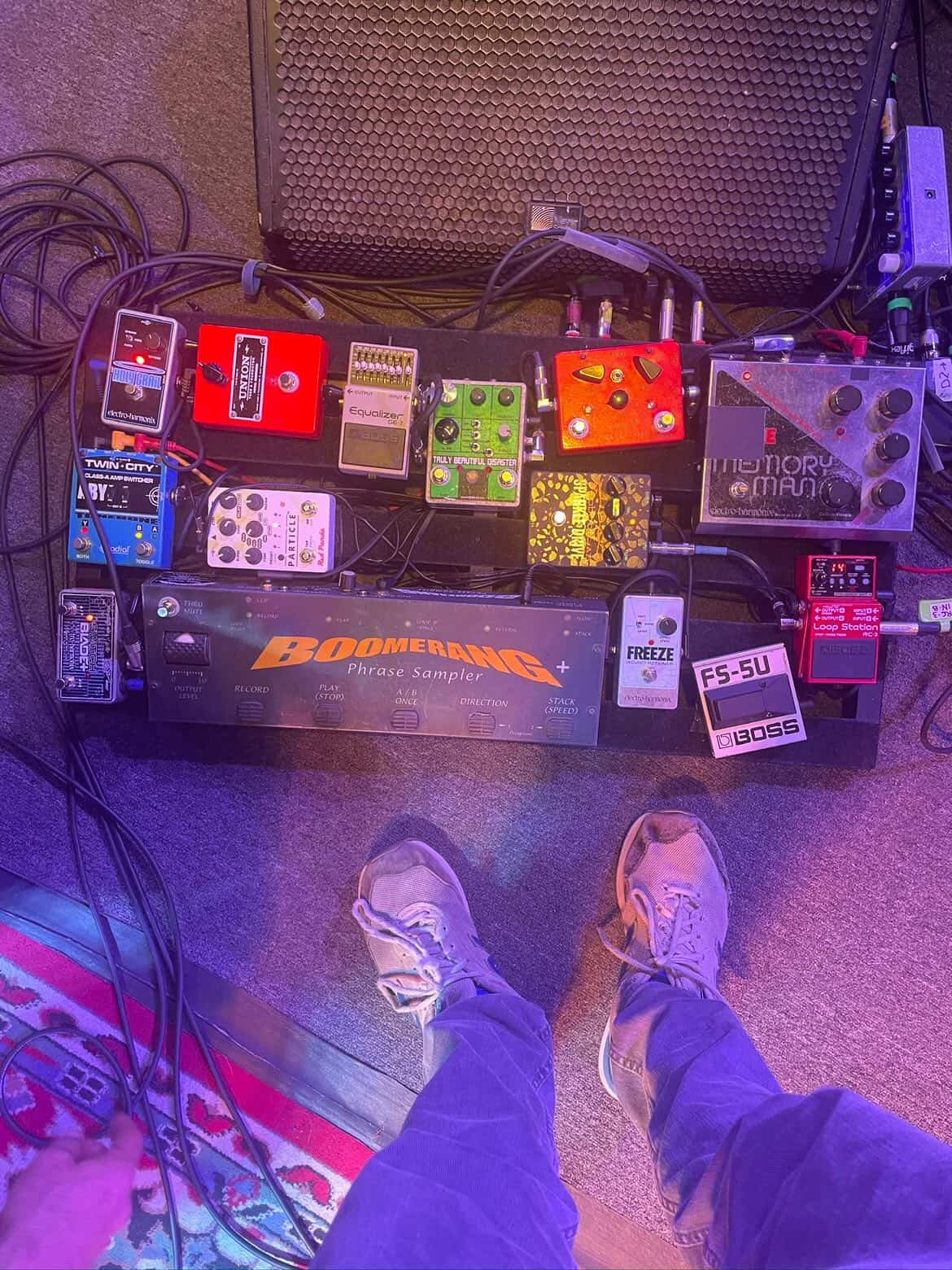
I have two pedal boards, containing an array of usual suspects and odd-ball pedals.
My main goal in assembling this rig was to have a setup for playing solo and as a duo with Andrew (drums) where I could split out to a sub-octave pedal and send that signal to its own bass amp, while looping the bass and guitar together.
I split the signal at the beginning of the chain with an A/B box.
- “A” goes through all the guitar pedals, into a Boss RC-2 Loop Station, and out to my ‘65 Deluxe Reverb and Supro Valco.
- “B” goes through the Boss OC-3 (sub-octave, able to set the low-pass to filter out high strings), through a compressor, ALSO into the RC-2, and into a bass amp. I also keep a mini Danelectro Honeytone amp mic’d up for some extra blown-out distortion
One key pedal for me is the Union Tube and Transistor “More” pedal. It’s a huge part of my tone.
If you could go back and give your 25-year-old self one piece of musical advice, what would it be?
Don’t be so precious about it all. More output. Don’t take yourself so seriously. Do what makes you happy, not what you think makes you matter.
What’s been your biggest challenge as a guitarist and musician?
Being disciplined about practicing.
What’s next for you musically—any projects or goals you're working on?
I’d like to record a new solo record over the next year with different people, different collaborations, recording a mix of instrument and lyric-based songs.
After this Barr Brothers album cycle and the subsequent touring, I’d like to get back to some live improvisations, picking up with different people in different cities when and where we can.
sThere’s also a back catalogue of Barr Brothers music, Slip music, and Surprise Me Mr. Davis music that I’d like to see come out. An album of some kind a year. That’s my goal.
⚡ Lightning Round
One album every guitarist should listen to?
Shakti “Natural Elements(with John McLaughlin)”
Desert island guitar and amp?
Martin N-10 (nylon) and a Danelectro Honeytone (runs on batteries, good for desert islands)
What guitarist should everyone know about?
Blind Willie Johnson
Recommended Listening:
- The Barr Brothers: Let It Hiss
- The Barr Brothers: Self Titled
- The Slip: Alive Electric & Alive Acoustic
- The Slip: From The Gecko
- The Slip: Does
- Surprise Me Mr. Davis: Self Titled