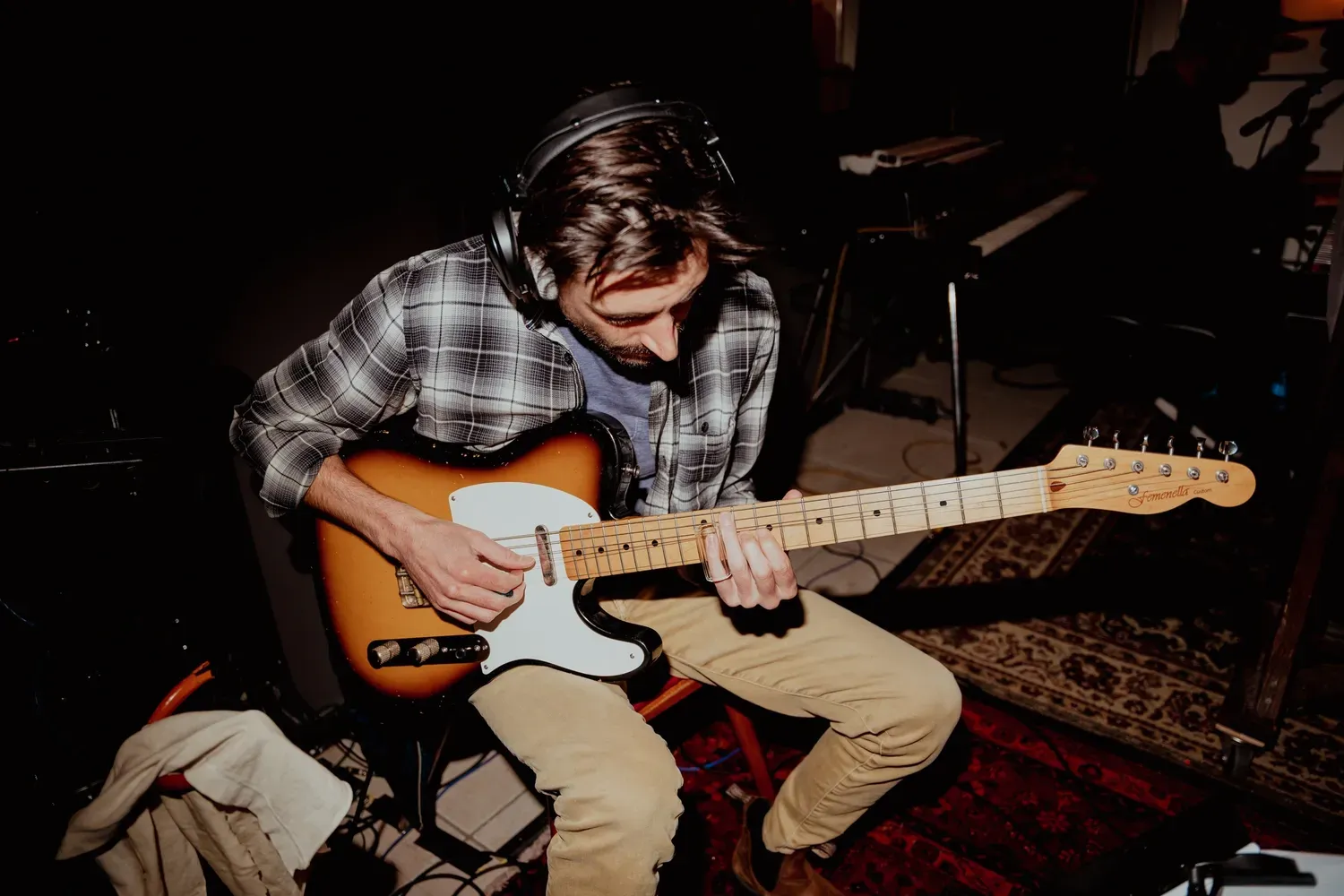

Chris Parker on Practice, Slide Guitar, and Creative Confidence
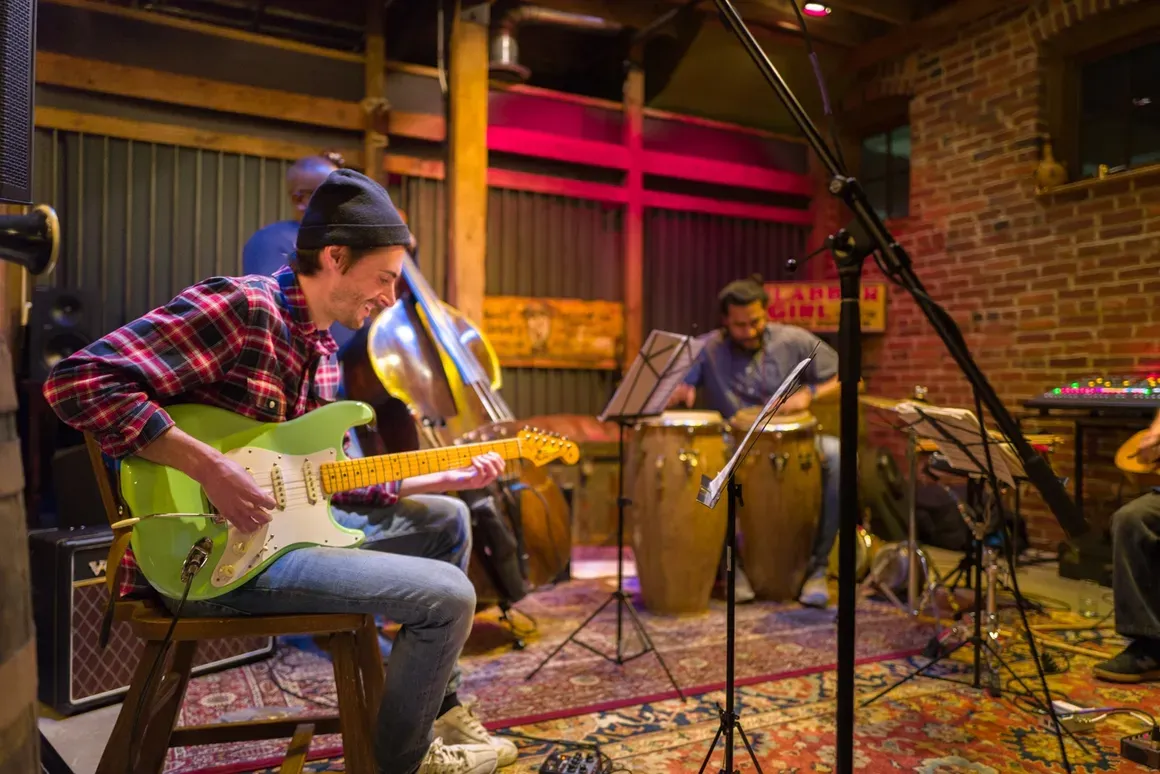
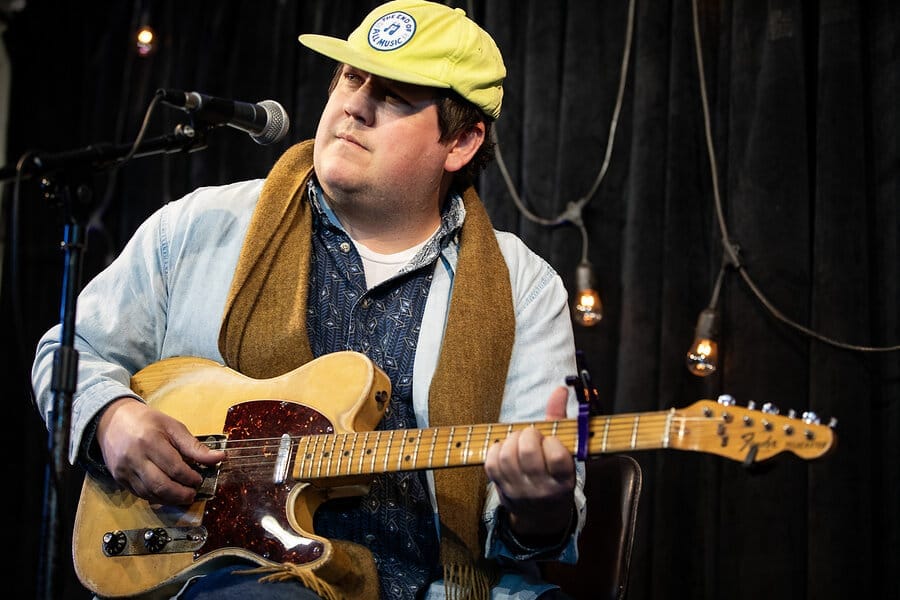
Chris Parker is a Brooklyn-based multi-instrumentalist, guitarist, and composer known for his wide-ranging versatility on stage and in the studio. He has built a strong reputation as a go-to sideman across an eclectic mix of musical worlds, moving comfortably between singer/songwriter accompaniment, tropical lounge-jazz, groove-heavy funk, and fully improvised music. Whether playing with artists like Christina Courtin, diving into the warm, vintage-leaning sounds of Kolumbo, or leaning into the wild, freak-funk energy of Breastfist, Chris approaches every setting with the same goal: to elevate the music and serve the song.
His adaptability and inventive guitar work have also led him to larger national platforms. Chris has appeared on The Tonight Show Starring Jimmy Fallon performing with UK artist Jade Bird, and on Saturday Night Live with Halsey—showcasing his ability to shine in high-profile, fast-moving musical environments.
In addition to his sideman work, Chris leads Guru Complex, his instrumental sextet that highlights his compositional voice, arranging skills, and increasingly signature slide-guitar sound. The group gives Parker a space to explore rhythm, texture, and melody on his own terms, blending groove-driven improvisation with tightly crafted writing.
Rooted in Brooklyn’s rich music scene and endlessly curious about new sounds, Chris Parker continues to shape a career defined by range, feel, and a deep commitment to making meaningful, exciting music.
🎸 Q & A
What does your current guitar practice routine look like?
Lately, it involves some warm-ups I devised to help strengthen my pinky, which seems to have gotten a little out of sync from wearing a slide on it for so long.
Then I mostly work on the music I need to know for upcoming performances. I kept learning this lesson the hard way: whatever you need to refine in your guitar playing will be exposed by any music - not just 'hard' music or something you think you ought to be working on, like ‘Giant Steps.’
I used to try to get to a never ending list of scales, arpeggios, etc. when I was younger, but I was never organized enough to feel good about it. It just seemed very haphazard and it ended up linking guitar with a sense of anxiety that ruined my relationship with practicing. When a gig would come up I wouldn’t feel very prepared on the music, which makes me play tentatively. But because I had been practicing a lot of scales and stuff I thought that the gig should have been better. That is a recipe for not feeling so good about yourself. So in the last few years I've tried to center my guitar practice on repertoire that I need or want to learn. In working out repertoire you end up with an arrangement you could actually use on a gig.
Also transcribing - it gives you all the answers. What notes do you use on a C7? I dunno, let’s see what Charlie Parker says, or John Coltrane, or etc. All the good stuff is in there if you learn it.
What's the best piece of advice you have for other guitar players?
Transpose. Play songs, basic chord progressions, licks, whatever you like to play in other keys. It will expose where your gaps are. It's the best way to really understand our extremely confusing and unintuitive instrument.
Standard tuning makes barre chords easy and everything else hard. If we are to relate the principles of harmony and melody that are obvious to our ears to our hands, then we need to develop a tactile intelligence that is more flexible and intuitive than just licks and grips. We develop that ability through learning musical vocabulary and transposing it around the instrument.
How do you stay inspired when you’re balancing so many different musical roles (sideman, leader/composer, multi-instrumentalist)? Do you have specific routines, listening habits, or “reset” practices?
When I need to center myself I always find myself coming back to the mantra “Bach, Bird, Blues.” Lately its been Bird (nickname for Charlie Parker if anyone is unfamiliar). I'll just work on bits of his compositions or solos and transpose them to different strings, try different fingerings, make my own variants etc.
It really connects me with the guitar rhythmically and gives me a feeling of control that somehow translates to any music. And I think that is the point of practicing: to maintain a sense of confidence on your instrument that you can take into any musical situation.
What gear (guitar/amp/pedals) are you using lately—and why?
I have an ever evolving strat project that really covers a lot of sonic ground. It has a gold foil (but soon to be P90) and a humbucker with coil split and out of phase switches.
My pedal board has been shrinking, but I have come to rely on a MXR Reverb that I control the decay/mix with an expression pedal for things like sustain, reverb throws, and continuous control rather than just on/off.
Also, the EHX Attack Decay is integral to getting non-guitar or synth-like sounds. It behaves interestingly with slide playing.
For amps I have a silverface Princeton that sounds great, but I usually roll around New York on the subway with my little ZT Lunchbox or just play amp roulette with whatever they have at the gig - that is part of the fun of living in NYC. It has kind of become a game for me - to see if I can get a bad amp to sound good.
Slide guitar is a specialty of yours now. What drew you to slide guitar, what makes it unique for you in the context of Guru Complex, and how do you approach it differently than “regular” guitar?
Originally what drew me to slide guitar was hearing Derek Trucks. But then I heard Tony Scherr on a Norah Jones track ('What am I to You?') and realized you could chord with your non-slide fingers. And then I heard Sonny Landreth and learned you could fret behind the slide. And then I heard Ry Cooder and realized you could compose and arrange a whole sound world around it. And then I heard Dave Tronzo and realized that there are really no boundaries at all when it comes to slide guitar.
The sound I was after with Guru Complex grew out of playing in a short-lived group with a master musician and percussionist from India named Samir Chatterjee. He taught us melodies by ear, and of course I tried to emulate sitar and sarod sounds and other non-western instruments.
I sounded nowhere close to the virtuosos that actually really play that music, but it opened a door to playing in a way that utilized buzzy sounds and other extended techniques that I hadn’t thought of before when i was thinking in a blues and rock context.
Also, when you hold a slide across the strings, there are so many rattles and buzzes that we are usually trying to eliminate, but I started to be really drawn to these percussive aspects and began to compose grooves and etudes that became the basis for some of the compositions.
My approach to slide guitar differs from how I think of “regular” guitar in the way I deal with chording. As anyone reading this probably knows, the slide gives you mostly just one option - the open chord that the guitar is tuned to, which makes it essentially a movable barre. Thanks to Sonny Landreth’s fretting behind the slide innovation you can ring slide notes along with fretted notes to change chord tones. But that only allows for the lowering of pitches under the slide. If you want to raise a chord tone or get a pedal steel bend, for example, you have to raise the pitch obviously.
It took a while to figure out how to bend strings against the slide from underneath - lap steel players do it from above with their free left hand fingers behind the slide bar and have a little more wiggle room. So conceptually, I think of the slide as a movable “0” fret and can get -3 or +2 frets without moving it, if that makes any sense to anyone out there. Some chords are still impossible or very uncomfortable, but it’s a work in progress. The beautiful thing about guitar is there always seems to be a workaround if you think on it long enough.
For emerging guitarists (or improvising musicians) trying to build a sustainable career: what would you say are the most important “business” or non-musical skills to develop?
Community building. Hanging around and being helpful without an agenda. People notice when you are being transactional and no one likes a ladder climber (unless they are too haha). Don't ask for guestlist; just buy a ticket and show up.
A career will take care of itself if you are really into music and are kind and useful to others.
What’s been your biggest challenge as a guitarist and musician?
Trusting myself. When I was younger, I was waiting for validation or permission from teachers and older musicians. By my mid 30s I started to realize that no one is going to give me 'the big gig' and that waiting for a 'big break' is not a plan.
You don't need permission from anyone to play the music that you think is cool. Almost every time I shared something that I was obsessed with in private but didn't think others would care, I was always shocked how it resonated with others. That happened with the faux pedal steel stuff I was working on: it felt like a party trick or something but when I shared it, people were really interested.
I ended up connecting with people all over the world who are slide guitar nuts and builders of bending contraptions, slides and etc. If you think it's interesting, someone else is going to think so too - and therein is your audience, your collaborators and like-minded people who are going to start following what you do.
What’s next for you musically—any projects or goals you're working on?
I am slowly learning how to be consistent with my output. As a sideman, I often let my own projects go to the backburner, but I notice that the artists who we all know and take for granted are simply the ones who put out a record every year and go on tour.
Easier said than done of course! But having a career seems to be more a function of consistency and persistence, provided you are doing something that people find interesting and valuable.
⚡ Lightning Round
One album every guitarist should listen to?
2 Drink Minimum by Wayne Krantz
Desert island guitar and amp?
Strat and a tweed champ
What guitarist should everyone know about?
Emmanuel Michael
News & Notes
- Steve Cropper, legendary American guitarist best known as a founding member of Booker T. & the M.G.’s and for his influential work with Stax Records, passed away at the age of 84. Steve co-wrote the classics Green Onions, Sittin' on the Dock of the Bay, and In the Midnight Hour.
- Fender announced/teased a Tom Morello "Arm The Homeless" Guitar. The signature model (which is coming soon) replicates his custom Strat which has undergone a huge array of mods and upgrades across its three-decade existence. You can enter to win a signed version of the guitar on Fender's site.
- Fender released a firmware update that added 4 new amps to it's Tone Master Pro - Fender ’65 Twin Reverb Blonde, Petrol, Hiway 105, and Fender Bassman TV. The release also includes 6 new cabinet impluse response sets, and 23 new effects.
- Robben Ford dropped by the Guitarist studios for a rig rundown featuring his his 1960 Tele and his latest pedalboard.
- The Always Getting Better podcast interviewed guitarist Mark Wraith — a London-based player and exceptional sight-reader currently performing on the hit musical Hamilton.
Enjoy this newsletter? Please forward to a friend or hit reply to share your thoughts.🤘